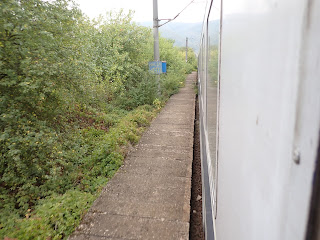
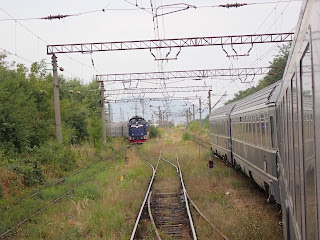
Tak tak – Tak tak – – Tak tak -Tak tak - - Tak tak – Tak tak – – Tak tak -Tak tak ...
40 years ago there were no cheap flights. In 1981, as students, we thought hard about how to reduce the cost of travelling to and from Egypt. To go there we first went to Berlin, crossed the border into the East and then took a flight from GDR’s Interflug airline. The flight left in the middle of the night frm East Berlin’s airport Schönefeld. We crossed the wall in the evening and found a bus to take us through the dark and lifeless streets of east Berlin to the airport far outside town.
The Acropolis in 1981
For the way back we bought a ticket from Cairo to Athens. It was the first time I was there. It was begin May and after the dusty and noisy chaos in the streets of Cairo Athens seemed to be a green oasis. We stayed a couple of nights taking in the sights of this paradise and then started the journey back to Germany by train.
Metro terminal in Athens 1984
Old wooden metro train in Athens 1984
The Greek railways always were an unreliable mess. Usually they got some used engines from somewhere and wore them out until the last one had been scavenged for spare parts until an replacement came by a friendly donor. The major line was from Athens up to Thessaloniki. There was an overnight train carrying through cars to as far as Munich. We boarded the train in the evening. In that time the seats of the compartments could be slid together to turn a whole compartment of six seats into a flat surface to sleep. However, everything was full and we were lucky enough to conquer a couple of the emergency seats in the aisle in the hope that somebody would leave during the night.

This unfortunately did not happen and so we still occupied our emergency seats when the train eventually crossed the border to Yugoslavia. From there it continued its slow journey through the gorges of the Balkans until it came to a sudden stop in the middle of nowhere. After a while the first people ventured outside to have a look and we followed with a jump onto the embankment. We soon discovered that the overhead wires were broken by a fallen tree. There was no electricity for the locomotive. It took hours until we were pulled to the next station. With many hours of delay we arrived in the central station of the capital, Belgrado, in the middle of the night.
Coffee and newspaper in a cafe in Athens
Only the two through cars were left at the platform of the silent station. But the two cars were filled to the last emergency seat. There was no way to get out of the station because they had locked the gates. It made no sense to leave the cars anyway because outside it was raining cats and dogs, there was no food neither beverages, it was cold and everything was dark and closed. We tried to get some sleep on the dirty floor of the aisle but there was regularly somebody coming through on his way to the toilet or outside for a cigarette.
Our stranded train in Yugoslavia
Eventually a grey morning gave us a chance to go to the station building to consult the timetable. There was another train leaving for Italy. Wet and cold we boarded it and eventually arrived in Venice in the evening. At that time it was possible to just hop onto night trains because next to the sleeper compartments they all also had regular seats. We took the overnight train from Venice to Munich. Overall it had taken us about 60 hours to get from Athens to Munich.
Passengers in Bulgaria
Sunrise in Germany
My daughter has just finished her high school and to celebrate they have organised a get together in a vacation house in Tuscany. In a world of burning forests, disappearing glaciers, biblical floods and tropical heat she wants to spare the environment and avoid to take a plane. So why not buy an interrail ticket and go by train? And I decided to go along with her to Vienna and then continue on to Greece via the Balkan on a route similar to the one we took 40 years ago.
Start of the trip in Utrecht
Until recently you had to buy an interrail ticket at the station or order it and then carry the precious paper along with you during the journey. Since very recently it can be bought as e-ticket and loaded onto an app on the phone. The big advantage is that you can practically buy it the day you leave and, even better, when you don’t need it right away, it is valid for one year and you can activate it the day you start travelling. The disadvantage is that you don’t receive a printed map any more to give you a sense of direction and possible connecting lines in stations. Fortunately there is a European Railway Atlas. It is very thick but of course it is possible to copy the necessary pages. There is also a printed timetable for the whole of Europe, but with the timetables in the interrail App it is not really necessary any more.
Boarding an ICE in Duisburg Hbf
The central European countries like the Benelux, Czech Republic, Germany, Austria and Switzerland are the heaven for the Interrail traveller. Except the nighttrains it is still possible to hop on any train including the high speed trains in complete freedom without mandatory reservation. That is different with the high-speed trains in France, Italy or Spain. The interrail App not onIy indicates in the timetable which train requires a reservation but in many countries also allows to make and pay for the reservation inside the app. However, there is no need for an interrail ticket in Romania and Bulgaria since trains are so cheap that it is better to buy a ticket at the counter or ticket machine anyway.
Full ICE's restaurant on the way to Vienna
Run on a departing ICE in Vienna
The new challenge are the regulations designed to prevent a further spread of the Corona virus. To be safe, I have not only a proof of vaccination on the App in my phone, but also the international yellow vaccination booklet, made a PCR test in the last possible minute and have printed the certificate. I did not even come into my mind that registering my entry online might be necessary in some countries. To be on the safe side I would not make any hotel reservations before I can be sure that I am actually able to arrive there.
The stations of the Metro in Vienna were designed by the Art Deco architect Otto Wagner. All are a jewel. This is Stadtpark
Everywhere they seem to agree that wearing a face mask is mandatory on all public transport. In Arnhem a voluminous woman in a colourful dress ask me whether she can sit next to me. Her masks sits at her chin. I answer, that she can sit down when she wears her mask properly. She pulls her mask up, but not for long. So I remind her that her mask does not cover what it should cover. She sighs and pulls the mask up again. When I am in Vienna I am free, she says. Apparently she thinks that wearing a mask in Austria is not mandatory. The mask game carries on until far in Germany. There are regular announcements on the train that the mask shouId cover both mouth and nose, but there is always a small minority who thinks that is not meant for them. On one train the conductor says to a passenger: “look, I wear this mask for a whole day without a break during work. Are you not embarrassed that you make such a fuss about it for just an hour?”.
Preparation for the Balkan: orthodox church in Vienna
In the Netherlands there are few other restrictions, although the Dutch railways NS seems to be convinced that a bicycle seems to be the main cause of infection and therefore requires a reservation to avoid bicycle overcrowding. In Germany, although most trains are more or less empty, some of the ICE’s are as full as ever. This applies in particular for those to Vienna. Strangely enough, in Passau, they leave one of the ICE units behind. It was empty on the way to Passau, but now, when it is needed, it is not there any more. The few people in the unit that stays behind move into the already packed train continuing to Vienna and I am happy to get a seat in the restaurant, which is full but only offers limited self service. Others have to stand all the way between the border in Passau and Vienna. There is happy drinking going on and masks, not obligatory while consuming, are quickly forgotten. Like in Germany, the QR code as evidence of vaccination, test or recovery has to be shown upon entering a restaurant in Austria. Likewise they ask for it when I check into a hotel in Vienna. On the trains nobody asks for anything.

D347 ready to depart in Vienna
Budapest Keleti station
D347, "Dacia" connects Vienna with Bucharest in an overnight marathon of about 19 hours. It took me many attempts to finally get an online seat reservation, which has to be changed to a printed paper copy at the counter of Vienna main station. When I board the train an old-fashioned, but clean and neat compartment is waiting. Best thing is – there is no air condition and the windows can be opened, so there is no chance that the virus is spread across the train.
Ilha station in Romania. The station master waves the train off
Simple stop in Romania
The tracks on entry to Simeria, Romania
The Romanian conductor arrives and checks ticket and reservation. He does not wear a mask and doesn’t ask for a vaccination certificate either. That will not change, for as long as I am in Romania nobody will ask for a certificate. However, he warns me: the Hungarians might want to check vaccination ticket and want to see the phone for the QR code of the interrail ticket. He also warns me that I might have a restless night because one of the other three passengers will board in Budapest, the other two only in Szolnok, after midnight. And there is neither food nor drink on this train. The hungarian restaurant was discontinued because of corona and in contrast to most of the other night trains there is nothing available from the conductor. No beer tonight.
Irina
The hungarian conductor and the passengers from Szolnok never show. In Budapest Irina, a woman from Bacharest, joins. With her bald head I think she might have been in hospital for a chemotherapy. She tells me that she has been on a mountain retreat for several month. When I asked her what she is doing she answers that she is a professional Zen nun. That doesn’t stop her of getting off the train at every major stop to smoke a cigarette.
The station of Brasov
Inside the station of Brasov
The platforms in Sinaia
The station of Videle on the way to Ruse

Between the Hungarian border and Simeria the train rattles slowly through narrow curves carved out of the mountain sides. The few villages look poor and deserted. Stations platforms are little more than a dirt dyke between the tracks. Modern Europe with its industrial farming and exaggerated need for security is far away. That changes after Simeria. Somebody has decided that Romania needs a modern railway. They are busy building a double track line with a modern station even for the smallest hamlet. All have high platforms, elevators and pedestrian bridges, a state of the art train information panel, but the old station buildings are abandoned. There are plenty of passing tracks and connections to the parallel old line, which is not used any more and full of rusty, unused freight cars. While they try to get rid of the points in western Europe for cost reasons they have so many here that the train seems to have difficulties to select which track to use. The others are rusty and the first weeds start to grow. With all the fancy stuff they did not think of replacing the level crossings by bridges or underpasses. So the local farmers with their tractors and horse carts still have to wait till the train has passed.

Change of engines in the station of Simeria
In Simeria they change the Diesel engine for an electric one which also brings an old fashioned restaurant car. It seems to be a family business. A woman prepares the food and her husband serves as a waiter. They prepare a decent omelette with salad and coffee for breakfast. My Zen nun compartment mate also goes but buys junk food like chips and pretzels for breakfast. Outside a flat landscape full of industrial archaeology and neglected villages passes by.
The Romanian train restaurant

Right on time, after 17 hours, the train arrives in Brasov. In the morning, on the train, I have made a reservation for a room in the old part of town. However, before I can take a taxi to go there I have to make a reservation for the continuing trains, to Sinaia the next day, and the day after to Ruse in Bulgaria. In Romania, all trains require a reservation. There is only one train a day to Ruse and I want to be sure to get a seat. While it is no problem to print a ticket to Sinaia from the machine it takes a long time at the only counter in Brasov station selling international tickets (although Ruse is just across the bridge from Romania….). The couple first in line try to go to Italy. The agent tries hard but there are no free seats. Eventually they give up. After another group for tickets to Vienna it is my turn to somehow make clear when and where I want to go. The biggest challenge is to show the information of the interrail pass, which is only on the phone. Eventually I am the proud owner of two tickets, a national one to Bucharest and an international to Ruse.

Buchuresti Nord station
Capitalism has definitely taken control
The international train to Ruse
The Balkans are full of spectacular mountain lines. One is between Brasov, Sinaia and Ploiesti. In Bucharest a dirty and graffitti covered but modern railcar arrives for the trip to the border. Between Bucharest and the border at the Danube river the landscape is flat. Endless fields of sun flowers and corn change with forests of oil pumps. The track between Bucharest and the border is in a deplorable state. In parts the train moves with the speed of a cyclist.
After a little while the only passengers on the train are interrailers. I sit next to a group of young germans who want to travel from Stuttgart via Vienna, Budapest, Bucharest, Sofia, Belgrado and Zagreb back to Germany in 4 days. A german family with 3 little children is on an interrail trip through the Balkan.
Inside the train to Ruse
State of the track on the way to Ruse
Fields of oil pumps in the Romanian Pampa
Eventually the railcar arrives at the border station Giurgiu Nord. On the neglected tracks of the big freight yard dirty engines and graffiti covered cargo cars are waiting. A couple of customs officers appear from the big, desolate looking station building. They collect a pile of about 30 passports and disappear. It takes some time until they come back. They seem to know exactly to whom they have to give a passport. And warn us that we will have to prove that we have a vaccination when we enter Bulgaria. I show my yellow booklet and that is enough.
The Romanian border station Giurgiu Nord
On the bridge across the Danube river
Shortly after Giurgiu Nord the train rumbles across the friendship bridge, one of only two bridges over the lower stretch of the Danube river connecting Bulgaria and Romania. The width of the river is impressive. Boats and the industrial buildings in the river port below look like toys. The bridge is 2223 m long and has a clearance of 30 m. There is a lower one track railway part and a higher 2 lane road and pedestrian part. The middle part can be lifted to allow the passage of taller ships. The driver of the railcar has opened the door to his cabin and allowed passengers in to have a look. On the Romanian side the train crawls across the bridge, picking up speed after the movable part in the section of the track belonging to Bulgaria. Below a long queue of trucks waiting at the customs control post. Both Bulgaria and Romania are in the EU, but do not belong to the Schengen zone, so there are passport and custom checks at the border.
In the station of Ruse
After derelict looking shunting yards and industrial sites we arrive in the main station of Ruse. Everybody gets off at the platform where, again, now the bulgarian customs offices are waiting to collect the passports. The platform already is quite busy because it is about time for the connecting train to Sofia to arrive. Since the train from Romania was late the transfer time of half an hour according to the schedule has shrunk to less than 10 minutes. We get a bit nervous because we are afraid that we will get back our passports only after the train has left. Eventually the customs officers arrive at about the same time as the train. Again they seem to be able to pick out the owners of passports from the big crowd on the platform without big problems.
The station master takes care of his perfect station
Train in the station of Tulovo
The station of Karlovo

The short train to Sofia is full. I share a compartment with the German family and their three kids who seem to greatly enjoy their interrail vacation. Most of the graffitti covered wagons used by BDZ, the bulgarian railway, seem to be bought used from Germany. The lack of air conditioning is compensated by the fact that the windows can be opened. I let my head hang out of the window to enjoy the warm summer breeze and the unobstructed view of the scenery while the train slowly rumbles along the one track line with a constant tak-tak … tak tak. Few scimpy looking settlements interrupt the empty landscape of rolling hills. But all the stations are spotless, freshly painted with flower beds, toilets and a station master in a correct uniform waving off the train. I take this train to Goma Oryahvitsa, There, to connect to Veliko Tarnovo, only 10 km away, I would have to wait for 80 minutes. Fortunately there is a taxi in front of the station who drives me right to the entrance of my hotel for a negligible fare.

The station of Veliko Tarnovo ....
...is kept shiny by the cleaning woman
The inside of the station in Goma Oryahvitsa
In medieval times Veliko Tarnovo was the capital of the Bulgarian Zar. The medieval town was on the spectacular cliffs between the bends of the rive protected within the walls of a huge fortress. Little besides the foundations is left of the houses. The lively modern town is on the ridge outside the fortress. My early arrival not only gives the opportunity to visit the ruins, but also go to the open-air opera show played in the fortress after sunset.
Veliko Tarnovo
The next morning I take a taxi to the quiet station of Veliko Tarnovo. It is as clean as the others I have seen from the train. A cat sits on the station clock observing the arriving travellers. The ticket counter is open and I buy my ticket to Karlovo. Shortly afterwards a cleaning woman arrives and sweeps the spotless tiles of the waiting hall. Nobody is allowed to go in until everything is dry again. Afterwards she continues with the toilets. Outside the masts with loudspeakers and flood lights remind of the communist past, when such a station would have been a top secret serving the purposes of the cold war.
Keep the window open
The train line from Goma Oryahvitsa to Dabovo crosses the Balkan mountains, most of it now protected as Central Balkan National Park. It is one of the great mountain railroads in Europe. A spiral and double spiral were necessary to master the grades. In Tulovo, I change into a train from Varna to Sofia. Varna is the main bulgarian black sea resort and the train is full of vacationers returning home. A woman has spread out her folding camping chair to sit in the entrance of our compartment. Another guy has fixed the open window with a clamp to prevent it from closing. I cannot understand what he says but he shows me every bird of prey he can spot from the window.
The train from the coast
It is a long sweaty walk through faceless new building blocks from the station of Karlovo to the hotel. But Karlovo has a lovely medieval town centre with typical bulgarian buildings with lush gardens. A short walk leads to the foot of the mountains where people swim in the pool of a cascade. Because of my backpack, Marco, a national park ranger mistakes me for a hiker. He explains the trails and huts in the mountains and the high chance to see bears on route.
The narrow gauge station of Septemvri

From Karlovo I take a train to Plovdiv, Bulgarias second biggest town and from there to Septemvri. Septemvri is the starting point of Bulgaria’s last surviving 760 mm narrow gauge railway to Dobrinishte. The number of narrow gauge tracks bears testimony of the lines former importance. Long rows of overgrown freight cars are the leftovers of the times when the line also was used for cargo. In front of the shed three rusty steam engines and abandoned railcars wait for better times. But there are still 4 through trains each way a day, although I ask myself whoever takes the train leaving Septemvri at 2 am. It takes 5 hours 20 minutes for the 125 km long climb from 238 m at Septemvri to 1,267 at the summit at Avramovo. This is the highest point of the line and the highest station in the Balkans. To go up there the line has to master 4 spirals, more than 3% grades and 35 tunnels. Interesting enough the Diesel engines working the trains were delivered in 1965 and 1966 by the western arch enemy Henschel AG in Germany.

The train up the mountains to Bansko
Bansko station
Bus station
After 11 hours on trains and in stations I think I have earned a nice bed and so I check into the Bansko Grand Hotel. Firstly, because it is next to the bus station and second it is the only one with a swimming pool. From here I have to take a bus leaving at 7 am to Blagoevgrad. The Greek railways are virtually disconnected from the rest of Europe. There is a railway from Sofia across the border to Thessaloniki in Greece, but trains run only to the Bulgarian border station in Kulata. There is no train from there in Greece and the only train lines operational in Greece to Athens and around Thessaloniki have little traffic and are of little use for me. Google knows more than the girl at the counter in the bus station in Bansko: There ought to be a direct bus from Blagoevgrad to Thessaloniki.
Counter for Greece in the bus station of Blagoevgrad
Snack bars in Blagoevgrad
Early in the morning I arrive at the run-down bus station in Blagoevgrad. The many potholes in the yard are filled with water from the rainy night. A couple of sheds sell coffee, junk food and snacks. The counter hall is half abandoned and empty and the counter selling bus tickets to Greece is closed. From the many diverging announcements in Cyrillic hanging in the window I can extract that there should be between one and three buses a day, at 9 am, 1 pm and in the evening. The counter might open at 9 am. As it turns out, it is a sunday and then it is 10 am. At that time a friendly guy arrives and sells me a ticket for a bus at 1 pm. I can leave my luggage for a tour of Blagoevgrad, a town of fascinating, mostly derelict communist architecture. But there are some friendly street cafes and I can pass a couple of nice hours.
Architecture in Blagoevgrad
In the station of Blagoevgrad
The bus which finally arrives from Sofia half an hour late is just a big van. But while there is none in the trains in the Balkans it has working wifi in Bulgaria as well as in Greece. In contrast to the railway running parallel, the motorway to the border is in perfect shape. In Kulata I can see that I did the right thing: there is no obvious way to get from the station across the border to find onward transport. A long line of cars is waiting to pass the border. While we wait a long caravan of fire fighter trucks passes in the opposite direction, probably aid returning home to Bulgaria from fighting the many forest fires in Greece this summer. We get off the bus and walk past the Greek officers. For the first time since I left Austria I have to show my QR code. However, the guy has no reader and so I discover that it is actually possible to open it to show the details in a readable form.
At the border to Greece. Returning fire trucks
We get off at the enormous and impressive intercity bus station in Thessaloniki. Unfortunately there is no public transport there. They are still busy building the towns first metro line. Because of all the archaeological artefacts found during the works the progress is slow. I can buy an onward ticket to the Ionian coast and take a taxi to a pleasant hotel in the centre of this surprisingly packed, but agreeable town full of historic monuments.
Bus station in Thessaloniki and in greek country side

To go back home via Italy we have to take a ferry across the Adriatic sea. There are plenty of ferries leaving from the Greek port of Igoumenitsa to Brindisi, Bari, Ancona and even Venice. However, the only ticket I can find is for reserved seats on a Grimaldi ferry to Brindisi. A friend, who had taken this ferry at daytime in the other direction has warned me. It is mainly for trucks, it is cramped, dirty, stinks from Diesel exhaust and sweat and the toilets are abominable. Our ferry leaves at midnight and we arrive by taxi at the terminal hours before because the reservation has to be exchanged for a ticket. Far before the ferry port the motorway is blocked by queues of waiting trucks. The taxi driver knows a way around and we wait in an almost empty terminal where numerous counters of different companies wait for customers. The Grimaldi counter hands out our boarding passes and confirms that there are no cabin places left. A departure panel announces half a dozen departures tonight. Strangely enough there are several with different names but identical departure times, or identical names with different departure times. There is nobody who speaks english and nobody gives any information. At the sea side of the terminal a sign announces bus transfer to the ship, but there are no buses anywhere, only trucks. Eventually we start walking between them across the huge waiting area towards a ferry, which turns out to be the right one, Euroferry Olympia. They just start unloading in the utmost chaotic way. Some of the trucks have to reverse out of the hull and turn outside, thereby blocking others. Some are so long and low that the back of the trailer hits the tarmac when they come off the ramp. The number of trucks coming out seems to be endless. To unload or load a train with the same number of freight cars would have taken minutes with a minimum of pollution, but here we stand in a cloud of exhaust. Eventually the same chaotic process starts for loading. Those trucks reversing up the ramp have to move very slowly. There is no separate access for pedestrians.

Ferry terminal in Igoumenitsa
Cabin in the ferry
Eventually the few passengers on foot are allowed in. At the entrance to the loading deck the boarding pass, corona QR code and temperature of the forehead are checked. A muslim family does not pass and is sent back. Inside an inferno of noise and exhaust of running truck engines. There is only one elevator. We take the stairs. I am covered in sweat when we finally arrive at the reception on the 4th floor. They show us a cabin where every second of the numbered seats is supposed to be kept free to allow for social distancing. Fortunately only very few of the seats are actually occupied. We can sleep stretched out on the benches, it is reasonably quiet and the toilets are acceptable. Probably at night the truck drivers sleep in the cabins. There are only few people who spend their night on the floor or on the few benches in the public areas.
Inside the ferry
Ferry terminal in Brindisi
Upon arrival in the morning in Brindisi the trucks block the passage out into liberty. When there finally is a passage, it is dangerous to not be run over by one of the trucks eager to get off the boat. Between the stampede we try to find our way out of the terminal, which is completely deserted. We are lucky to catch the only taxi waiting for arriving travellers to go to the station.
The end of the Via Appia in Brindisi
The station of Bari Centrale
Napoli Gianturco
Roma Tiburtina
In the antique, Brindisi was the main Roman port to sail to the eastern Mediterranean. Two branches of the Via Appia ended here. Little is left of the Roman town. But the end of the Via Appia was marked by two column above the staircase leading down to the sea. One of them is still complete. On the way to Monopoli, a little north, the ruins of Egnazia give an impression of a Roman town.
Waiting high speed trains in Napoli Centrale
Waiting passengers in Napoli Centrale
High speed on the way to Rome
The railway north still follows the ancient route of the Via Appia Traiana first along the coast via Monopoli to Bari, then across the mountains via Benevento, Caserta, Capua to Rome. After a short ride and a night in Monopoli we take trains to Pompei.
Waiting for the train in Monopoli
Napoli Centrale
The bag with mask and disinfectant for passengers in Italian high speed trains
The first chinese travelers are back

The italian railway FS takes Corona serious. There are constant announcements in the stations and on the trains to keep distance and wear masks. The masks should be changed after 4 hours. On the local trains an announcement counts out the number of seats and standing places, how many percent can be occupied and how many people are allowed on the train. For boarding a high speed train in the major stations like Napoli or Firenze a separate area is fenced off where they not only check reservations but also have set up equipment to check temperatures. There are marked doors to get in and others to get out. On the floor of the compartment a line indicates the walking direction. On the trains the conductor checks tickets, reservations and the QR code certifying vaccination, test or recovery. Everybody wears his mask. After boarding a high speed train a guy with a trolley distributes bags with disinfectant, mask and a bottle of water to everybody. Many are thrown away unused.

High speed versus local train
They are there again, although not many. Regardless of restrictions, there are little groups of chinese, japanese and american travellers. They have to use the local trains now since they cannot produce the European QR code. I was afraid that making a reservation on the busy high speed trains would be difficult. However, most are very empty. Making the reservation with the app available in the mobile interrail ticket is easier than buying one at the counter at the station. It is difficult to explain what you want if you cannot speak Italian.
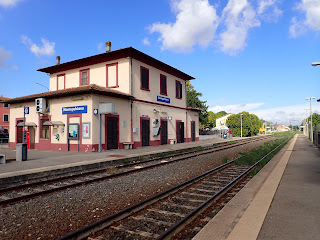
The station of Montepulciano
The station bar in Montepulciano
The train arrives
From Pompei we continue via Montepulciano in Tuskany to Venice.Between Rome Tiburtina and Firenze we use local trains. This still are the lines of old railcars and Diesel engines, coaches where opened windows let in the tepid tuscan air and let escape whatever is left of virus inside. The station of Siena is the centre of this railway paradise, where different non-electrified lines come together.
The station of Siena
Despite Corona and the virtual absence of cruise ships Venice is full. The direct night train from Venice to Munich is full too. There are spaces left on the night train coming from Milan between Padova and Munich. But they only have got seats. We leave the overcrowded alleys of Saturday night Venice early and rather wait for 3 hours in the quiet of the platform of Padova station for the night train to arrive. Due to Corona only three of the six seat are occupied. The seats can be moved together like in the old days to provide one big mattress like platform where three people can comfortably sleep. Even the passport control of the over-eager bavarian authorities in the middle of the night reminds of the old times of interrail travel.
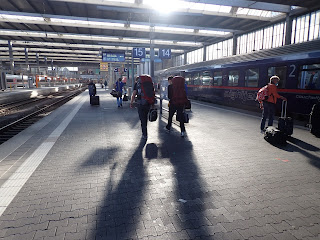
München Hbf
Duisburg Hbf
Sources
Fik Meyer, Via Appia, Atheneum 2017
Waiting departing passengers in the airport of Athens 1984
Link to the previous post: