Tuesday, July 6, 2021

Corona walks, number 6, Oudenbosch


The arrival of Rome in the Netherlands….


The 80 year war of independence of the Netherlands from Spain has also been a religious war as the consequence of the reformation. The “geuzen”, the fighters who, in the beginning under Willem of Oranje, started to fight the Spanish, were Calvinist groups. One of their goals was religious freedom in the Netherlands. Philipp II, the spanish king, was a catholic hardliner who could not accept religious deviants in his reign. What is scarcely mentioned is that the supporters of the reformation were a minority. While the southern part of the Netherlands in what is today the state of Belgium never embraced reformation and stayed catholic, even in the northern provinces, the catholics were in majority. Towns like Antwerp and Amsterdam were predominantly catholic. After their official victory in 1648 the calvinist winners and rulers of the seven provinces did exactly what they had fought against during the war: suppress everything what was different. That not only included the catholic majority, but also other protestants like lutherans, or remonstrants and anabaptists. For almost two centuries believers of other religions had to keep a low profile. Catholic church service was only allowed in clandestine churches. As Jan Blokker called it: “There was only a gradual difference (between the treatment of the members of the other religion): no catholics have died on a protestant pyre”.


The cemetery of Oudenbosch


In the background the cupola of the cathedral

Already in the 80 year war catholic monasteries had been sacked and the protestant disapproval of ornaments in churches led to the iconclasm, numerous works of art in the churches were destroyed or carried away. After 1648 the intolerance against other religions led to the conversion of catholic into protestant churches. This also happened in the little village of Oudenbosch in North Brabant, about halfway between Brussels and Amsterdam. On March 3, 1649, the Catholics had to give up their church to the Protestants; only in 1684 they got permission to build a replacement church in a barn. Only in July 1799, the original church was reassigned to Catholics by the French occupiers. This reassignment was based on the number of parishioners.


One of the mansions in Oudenbosch

The area around Oudenbosch had been hit hard by the 80 year war. Subsequently two waves of the pest all but wiped out the local population. Only around 1825 the local economy started to grow again. Oudenbosch is located on the transition between sand and marine clay, and the soil turned out to be favorable for tree nurseries. But also brickworks and sugar mills were found in the area. The village had a harbour and traffic to Zeeland and South Holland, among others, was easy. In 1854 a station on the new railway line between Antwerp and Rotterdam was opened. The local economy begun growing. The owners of the local enterprises started building stately mansions in the main street of the former village, some fine examples of which still can be seen.


In 1842 the ambitious and energetic Willem Hellemons became pastor of the predominantly Roman Catholic population until his death in 1884. Pastor Hellemons had studied in Rome. He was very excited about what he had seen there and in particular the churches and tried to turn Oudenbosch into little Rome. He initiated the building of the basilika H.H. Agatha and Barbara built between 1865 and 1892. It was inspired by two roman churches: The dome was modelled on St. Peter's Basilica in Rome, and the facade after San Giovanni in Lateran. The church, which is a 16:1 copy of the original in Rome, was built by architect Pierre Cuypers who also built the Rijksmuseum in Amsterdam.


The interior of the cathedral and a believer in his tenue


The cupola


Prayer in times of Corona

Hellemons also found separate catholic boarding schools for girls and boys in Oudenbosch. Today the buildings of the St. Louis Institute, the boarding school for boys, still line the grande cour in the heart of Oudenbosch. It was run by the Congregation of the Brothers of Saint Aloysius Gonzoga, better known as the Brothers of St Louis.

The grande cour


The Vincentius building of the Saint Louis boarding school has been built in 1843, inspired by Roman architecture and completely white plastered. There were classrooms on the ground floor.


Many of the buildings still show signs of neglect

The first floor was a dormitory. The wing on the north side was built in 1900. In 1909 the construction on the south side expanded. At the entrance are the inscriptions Custodi innocentiam (keep the innocence) and Castitas ni floreat institutum pereat (If purity does not flourish, the institution will perish). We will see how well these inscriptions predicted the future of the school.


Until 2003, the buildings were part of the boarding school. In 2014 they were turned into apartments.


The front building was built in 1923 to a design by architect Bennaars. Above the front door are beautiful tile pictures. The ground floor with the entrance, reception rooms and a visiting room with wooden walls and stained glass panels was called the “Box”. The upper floors were sleeping areas with wooden chambrettes and sanitary facilities. The dormitories were later converted into smaller rooms for the youngest students and single bedrooms for the older students. The front section remained in use until 1996 as a boarding school. Later they were converted into offices and apartments.


The entrance of the St. Louis institute 

The Chapel at the head of the grande cour dates from 1865. Remarkably it was planned by Th. Horschutz. The art teacher at the institute. and Josephus Boosten, a brother. The chapel is, like the Basilica, modelled after St. Peter and San Giovanni in Rome. After serving 144 years as a church it is today used for concerts, parties and receptions.


The first thing to discover in Google after searching for the institute of St. Louis in Oudenbosch are numerous victims of abuse searching for fellow sufferers. In the 1960s brothers who taught at the school assaulted students at school and in summer camps. The children were told to never talk about what had happened since that would in particular hurt the parents terribly. Many of the victims had been scarred for a lifetime. They only came up with their story many years later, after the school was closed, culprits long gone and it had turned out that the cases were widespread.


The main street of Oudenbosch


In the beginning of the 19th century Italy was an assembly of numerous separate states. In the center, the papal state occupied a territory the size of the Netherlands. With the rise of a national identity the red shirts under national hero Guiseppe Garibaldi started to conquer the separated states to unify the country during the resorgimento. The papal state, which separated southern from northern Italy, was in the way of national unification. In 1860, Victor Emanuel II, king of Sardinia, conquered a part of the papal state. Pope Pius IX only retained Rome and surroundings, and was afraid to lose all his territory. However, the papal army was small, badly organised and unable to defend the papal state. The pope called for young catholic men around the world to come for help. Under the command of a french general the "Regiment of papal Zouaves" was found in 1861. From 11.000 volunteers who turned up eventually, 3100 came from the Netherlands.


The old station of Oudenbosch from where the Zuoaves left for Rome 


The journey for the volunteers began in Amsterdam where they had to register with the Catholic authorities. After they were inspected for physical fitness they were forwarded to the central departure point in Oudenbosch, which served as main collection and departure point between 1864 and 1870. The main reasons that Oudenbosch was selected were the space available in the St. Louis institute, the good rail connections and the network pastor Hellemons had built up during his student days in Rome. He had met the future Pope Pius IX and when this Pope made his appeal for help in 1861 to fight against the Italians, Hellemons wholeheartedly supported this. Since that time some neighbourhoods in Oudenbosch have Italian names like Velletri, Monte Libretto and Albano, which refer to the places in Rome, where the papal Zouaves had their barracks.


The Lourdes grotto in the park in Oudenbosch

Although there were some successful battles the Zouaves eventually could not stop the overwhelming manpower of the red shirts of Garibaldi. In 1870 the Italian army occupied the remaining papal state, the pope retired as prisoner into the vatican and the Zouaves returned to their countries after receiving the papal benediction. According to dutch law, a man who takes service in a foreign army loses dutch citicenship. After returning to the Netherlands, many of the former Zouaves lost their Dutch citizenship and were not eligible for any support. Congregations were formed to help the returning men. Some became mercenaries and continued to fight for other employers.


The church and park of St. Willibrord

The new religious freedom in the Netherlands in the 19th century led to the building of more catholic churches and the formation of monasteries.


One of the most important sites of pilgrimage in the catholic world is the grot in the French town of Lourdes. In 1925 an imitation of that site was built in the little town of St Willebrord not far from Oudenbosch. Next to an enormous church a scale 1:4 imitation of the grot in Lourdes was built.


The imitation of the Maria grotto of Lourdes in St. Willibrord

These places are surrounded by a park for processions, which also imitates the park in Lourdes, and a ditch, which symbolizes the river Gaves of the French town. However, in the meantime, the park and the kreutzweg built in 1932-1934 fell into disrepair. Only two of the 14 stations are left. In 2010 park and kreuzweg were renovated and statues of the villages’ pastors were added.


After the French revolution monasteries had a difficult time in France. The monks looked for new places to set up their order. Close to the border to Belgium, between the states of De Moeren and the Pannenhoef, a Trappist monastery, complete with an estate, consisting of cultivated land, forest and heath was found on land donated by a a believer. Since the new monastery was found by monks from France the new project got the name ‘Maria Toevlucht’. Eventually a church, monastery, sheds, bakery, washery and forgery were built. The community reached their biggest extent in 1950, when 80 monks lived here. Interesting enough the liturgy was in Latin until 1960, when a slow process of translation into Dutch started. A translation of the psalms was only available by 1975. In this time ZEN meditation and Yoga was introduced into monastery life.


The church of the monastery Maria Toevlucht

In the Netherlands and Belgium the Trappist monks are mainly known for their ability in beer brewing. However, Trappists only exist from 1892, when the monastic order of the Cistercians split into two independent orders, that of the ‘Ordinary Maintenance’ and that of the 'Strict Maintenance'. The latter became Trappists. Ideals of this order are an extremely frugal life (including vegetarianism), manual labour, and minimal contact with the outside world. Economic independence was guaranteed by clearing wasteland, clearing forests and draining swamps. For a long time cattle breeding for milk and beef were the basis for the economy of the monastery. In 2011 the breeding of cattle ended. The monastery land was turned over to nature conservancy Natuurmonumenten and the monastery started to use the farm buildings for beer brewing. Upon its introduction in 2019 the heavy dark beer ‘Zundert 10’ immediately won the golden medal of the Dutch Beer Challenge.


However, even all the changes introduced into monastery life could not prevent the community from becoming smaller. Although the precinct of the mnastery is guarded like a military camp, today, guests are welcome and can participate in the tranquillity of monastery life complete with meditation and vegetarian food.


Cattle on the former monastery land

The Netherlands have a long lasting heritage of religious fragmentation. Even the reformed church split up between more orthodox and more liberal groups. The different religious groups caused the so called “verzuiling”, the formation of pillars of religious groups supporting their members and these only which split society, politics and even economics for much of the 20th century. Only with the liberation movement in the 1960 and 1970ies the influence of the churches diminished. It is questinable whether this is a lasting development. The frontier between christian and islamic groups is toughening and it can only be hoped that ways are found to increase the mutual understanding.


Lanes on the estates around Maria Toevlucht

Sources:
Jan Blokker, Waar is de tachtigjarige oorlog gebleven? Rainbow, Amsterdam 2013


Link to the previous post

Tuesday, June 22, 2021

Corona stories number 68, China 1998

A lost world


When we came to Beijing for the first time in 1986 it was the sleepy capital of a third world nation. There were 9.2 million inhabitants but little was going on. There were few restaurants. The main reason to go there were the sights of a spectacular past. The impression of sleepiness was increased by the huge Tiannamen square, the center of the town and the nation, with the entrance to the Forbidden city on one side, the Hall of the people, the Mausoleum of Mao Ze Dong and the National museum lining the others. The square, supposedly the world‘s largest, was basically empty. Some forlorn visitors disappeared in the vastness. Mao’s portrait was looking down on the little traffic on the thoroughfare along the entrance side of the forbidden city. A few buses and the odd truck shared the wide streets of the capital, while the cycle paths, almost as wide as the lanes reserved for motorized traffic, were filled with throngs of bicycles.


The empty streets of Beijing in 1986

Only 12 years later the town had 7 ring roads, which were all chocked with traffic. This was 23 years ago and they had just started to built all these enormous examples of modern show case architecture which seem to determine the skyline today. We were on a business trip then and one of these late additions was the lufthansa hotel, where we had to stay. Every morning a driver came to pick us up and tried to compete with the cyclists in speed. They were faster because the roads were full. And that despite of his reckless way of dealing with his fellow motorists and also the cyclists. He even used the cycling path occasionally to pass the standing mass of metal by constant honking and cursing from his window to shoo away the cyclists. I asked our host whether we not rather could get rental bicycles for the few kilometres of commuting, but this apparently was not appropriate for such important visitors. It usually took more than an hour for 17 km one way.


The traditional housing in the old town of Beijing were in Siheyuan‘s, living quarters built around a central court yard with a gate in a wall facing the street. The houses line narrow alleys called Hu-tong which are laid out in a chess-board pattern, which constitutes neighbourhoods called with the same name. Accessibility with anything bigger than a tricycle is difficult, in particular since a part of the space in the lanes is occupied by parked bicycles, food stalls, tables with old men playing chess and a wide variety of open air businesses.


The narrow lanes of the Hutongs


What seems to be chaotic at first sight is the consequence of meticulous traditional confucian urban planning. Hutongs were first established in the Yuan dynasty (1279–1368) and then expanded in the Ming (1368–1644) and Qing (1644–1911) dynasties. The royal palace was situated in the southern part of the city called the grand capital. The city walls formed a square with 11 gates. The gates opened to streets 25 m wide running from west to east and north to south. Joining the major streets were smaller ones about half of the width. To the sides of this overall pattern alleys 6-7 meters wide gave access to the residences called fire-alleys and passageways. Originally there were 384 fire alleys and 29 passage-ways. Later an additional southern city was added which followed a similar pattern. The number of alleys and lanes kept increasing and a census done in the 1980‘s counted 6100 in the city and the suburbs. In the map of 1985 the original street pattern with the 11 gates is still clearly visible.


When building the grand capital the Yuan dynasty rulers decided that one family was to occupy not more than 0.6 ha of space along the alleys. A small house had two bays of rooms in the north, two on each side to the east and west and two to three in the south. Bigger houses had several courtyards each with similar arrangements.


Hutong taxi 

In recent history, as a consequence of population growth and redistribution of property it became uncommon that a house was used by one family only. More and more people were squeezed into the available space and additional, sometimes makeshift buildings were added in the area of the courtyards. The old parts of town became densely populated. The sanitary facilities in the courtyards are poor. Many do not have flowing water or toilets. Public toilets in the alleys serve the residents of the surrounding courtyards.


Open air bicycle repair 

For the visitor these public toilets are a benediction. It is never difficult to find one. Usually you only have to check where the wind comes from and follow the smell. Then you have to figure out which entrance is the right one for your sex and you can enter. Inside the dark cavernous space there is little privacy. Flowing water runs along a ditch in the ground along the wall. Bays are separated by one meter high walls. You let down your pants and kneel down above the stream, carefully taking care that none of your properties touch the slimy floor. While you wait until your target is accomplished you can watch the top of the head of the guy upstream of you. If he is successful you can observe his product floating downstream in the ditch below you. The most difficult thing is to not faint.


The renovated Hutong street close to the Confucius temple  


In the mid-20th century many Beijing hutongs were in a deplorable state. This, the growing population and the poor sanitary situation led to the demolition of Hu-tongs to make way for new buildings and wider roads. People were moved to big apartment buildings. It was the biggest change in the city since the 13th century. However, many missed the intimate social structure of the Hu-tongs, the life in the narrow streets and the common gardens. More recently many hutongs have been designated as protected, in an attempt to preserve this aspect of Chinese cultural history.


Demolition of Hutongs


One of the reasons to start a complete makeover of old Beijing was the China’s application for the Olympic Games. Beijing was notorious for its bad air, smog, dust and sand storms blowing in from the desert to the west. To improve the air the year 1986 saw a big tree planting campaign. 1 million trees were planted in one week. 


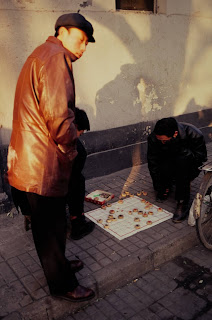
Playing chinese chess in the streets

During our stay in 1986 the tree planting campaign was followed by a anti-spitting campaign. The sound of somebody near you clearing his throat and spitting the contents somewhere on the side-walk close to you was common everywhere in China at the time. Colorful flags now reminded the citizens that this was not done.


To improve the look of the city, building and renovation projects were ongoing everywhere. High rises started mushrooming up in the periphery of the city. Old temples which were neglected or even destroyed during the cultural revolution were renovated or even built new from scratch. And even part of the Hutongs were renovated and modernised.


Letting nightingales sing is anther favorite of old men

Like many chinese cities Beijing had a bell tower and a drum tower from 1420 serving as a public clock and to warn the citizens of war and fire. In 1986 they were busy renovating what had been neglected for a long time. Other famous sites like the Lama or tibetian temple, the temple of heaven and the forbidden city already were full of visitors in 1986.


Renovation and renovated 


Already in the 1980’ies when China just opened up for foreign visitors the imperial palace or forbidden city was visited by 10.000 tourists a day. It is the symbol of imperial china. In the 13. century the first Yuan emperors decided to move the capital from Nanjing to Bejing. Between its completion in 1420 and 1911 it served 24 emperors of the Ming and Quing dynasties as residence. It occupies an area of 720.000 sqm, is surrounded by a 50 m wide moat and a wall of more than 10 m high with watchtowers in the corners. When Chiang Kai Chek with his national army fled to Taiwan the palace was plundered and many artefacts were taken along. It is a miracle that the structure survived the iconoclasm of the cultural revolution. Maybe it was protected since the communist leaders had and still have their residences in a part of the walled city like the new, modern emperors.


The forbidden city in 1986 and 1998


The visit in 1998 was in the middle of winter, ...


.... so pictures from both times are easy to distinguish


Another symbol of imperial china which survived the iconoclasm is the summer palace, the garden of harmonic unity. Although it dates back to the 12th century it reached its present size of 290 ha only at the end of the 18th century. First french-british troups devastated the garden in 1860, then again in 1900 western troups crushing the boxer rebellion destroyed the garden and burnt buildings. The 728 m long, covered wooden walkway which is completely painted with scenes from chinese traditional life was also destroyed. That was the time of empress dowager Cixi, who ruled china for 47 years between 1860 and 1908. After each destruction she raised the enormous amount of money necessary to rebuilt the park. Part of the money had been reserved for providing China with a modern navy. Consequently the naval battles in the Sino-Japanese war of 1894 were lost. Aground at the shore of the huge lake in the centre of the summer palace is a 36 m long stone ship. Rumor has it that it was built as a reminder to where the money for rebuilding the park came. With hindsight from the future there is no doubt that the money was better spent on the garden. Park and dowager would be worth a story on its own.


Cixi's stone boat in the lake of the summer palace


1986 was the time before everybody was hypnotised by his mobile phone. To keep contact with friends and family at home you had to resort to difficult and expensive international calls or to letters stored as poste restante in the post office. We went there. The poste restante mail was nicely arranged alphabetically in boxes. We had not received anything. That was not only disappointing but outright alarming because my father at the time was seriously ill and had been hospitalised when we departed. After a deposit of 50 FEC I tried to post a call home but nobody picked up. Eventually we went back to the boxes and upon closer examination we discovered that the chinese knowledge of the western alphabet is not perfect. A part of the letters for addressees with a name starting with S were filed elsewhere. So eventually I discovered a letter from my mother.


In the era of mobile phones it is hard to understand that there were times when it was difficult in Beijing to make an ordinary phone call. In 1986 the first telephone cells had started to appear in the streets but the telephone network was far from perfect. It also was the time when you had to reconfirm a return flight with the airline 3 days in advance and when flight bookings had to be made in an office in person, and not online. Organising these practical things cost a big deal of the available travel time. And transport with the old city buses was slow and it was not easy at all to find the right office. Eventually we were able to book an ongoing flight to Nanjing and do the reconfirmation of our flight back home after we had spent hours walking and on buses to find the right office.


The beginning of modern construction

Another uncommon thing at the time were credit cards, let alone the now popular electronic ways of payment. There were the ordinary Yuan banknotes and the special money for foreigners called Remmimbi, FEC (foreign exchange certificate). There was a lively black market for money exchange in Yuan. However, many places only accepted FEC, the money designated for foreigners. Some of the black market money change thugs also had another goodie on offer, habblibabbli, the local name for Marihuana.


We have dinner in a decent looking restaurant where we order what the others eat since we do not understand anything written on the menu. A young chinese couple is helpful. The man, 22 years old, is studying medicine. Afterwards they want to go to Tibet. They are aware that as Chinese they are not popular in Tibet, but they see their task with a kind of missionary zeal: it is their destiny to bring the superior chinese culture.


The Beijing hotel

The place to be as a Veigoran, a long nosed foreign expat, is the Beijing Hotel. Colonial flair surrounds pretty girls accompanying foreigners in pinstripe suites. According to Angus, an irish teacher at the british school in Beijing, the hotel houses the most expensive whores in town. However, coffee or Coca Cola go at a price acceptable for such an institution.


Pouring tea in a restaurant

While Angus showed us around town in 1986, in 1998, as business travelers, we had a girl who’s task it was to take care of us. Each day at lunch time she brought us to a different restaurant and she was very eager to impress us with the great variety the chinese cuisine had to offer. After some days she told us how impressed she was that we were ready to eat almost anything and asked whether we had a wish for something special. At the same time we both came up with dog. It was in december and she said that the cold season was the ideal time for that, since it would warm the body from inside. A couple of days later she ordered dog stew. It was excellent, like veal, and I still ask myself why such excellent meat is running around in the streets without being used.


Meat for sale in the street


Chicken in the pot 


Small and big sweeties


While we walk around in the quiet evening streets of Beijing in 1986 we pass the Beijing concert hall. At the entrance somebody offers me a ticket. It turns out that I have a privileged seat in the middle of the first row of the balcony. But the building is well planned and even the back rows have a good view. I am a bit embarrassed because of my shabby outfit in a green Mao jacket and blue jeans. The people are very well dressed here. However, everybody is friendly and my neighbors explain the program to me, which I cannot read since it is in Chinese. They play Brahms, Tchaikovsky and Dvorak.


Restaurants and food stalls in the Hutongs


Many people come late but they are very enthusiastic. Applause is given at every occasion, also in the middle of a set. At the end the orchestra has to play two encore’s. The overture of Strauss’ Fledermaus does not really fit to the rest of the program but the auditorium is enthusiastic. When it is followed by the Radetzy March they become frenetic. I would not had expected such an enthusiasm from a people regarded as egalitarian, indifferent and apathetic. The other night life on offer was chinese opera and acrobatics. The year before austrian artist Andre Heller had made chinese acrobats famous in Europe for the first time with the “begnadete Körper” tour. The opera plays Shakespeare's Othello. It is clear that the chinese director only has a vague idea of the medieval times in Europe.


Acrobatics show

In 1998 we discovered that Beijing had developed some kind of Night-life in the years that had passed. In one of the older neighborhoods was a variety of restaurants and bars. One had life music and we were led to a table. After a couple of beers we even dare to dance. Our jackets we left hanging across the backrest of the chairs. When we come back the wallet of my colleague is gone, a thing which had been inconceivable 12 years before. With the money, the credit cards in the wallet were lost. Fortunately they had already scanned it for the hotel bill and therefore he had paid for his stay.


Entrance and the cable car at the great wall in 1998


Our stay in Beijing comes with a touristic program and our lovely guide takes us to all those sites again which I had seen 12 years before. If there is no war, a cultural revolution or a natural disaster, touristic attractions do not change very much. The change is in the number of visitors. To accommodate the masses they have adapted the great wall at Badaling, the part of the wall most people visit from Beijing on a guided tour. A cable car brings visitors to the highest point of the snaking monument. Walking down-hill is much less exhausting. At the entrance a digital clock counts down the time left until the lost colony of Hongkong returns into the heaven of the motherland.


Taking pictures is one of the favorite pastimes of the chinese. Every pose is carefully arranged and then it takes even longer until the settings of the camera is right. For those few without there are professionals which also supply the fitting entourage. Photos can be taken in historic dress, while riding on a camel or while shooting arrows at an imaginary mongolian enemy. You can visit different mongolian yurts, which all charge an entrance fee.


Although much has been renovated, the wall becomes much more original the farther you go from the entrance. The main attraction is the landscape and how it was built regardless of the grade of the slopes. Here the noise of the tourists gives way to the rustle of the wind in the branches, the sound of birds and the exhausted puffing sound of several engines which pull and push the train up the slopes of the railway close by.


The 1986 guided tour came with a visit to the 13 tombs of different Ming emperors. Also empress dowager Cixi is buried here. Alleys of stone statues lead to the tombs. By then only one was excavated. When we visited 12 years later they had removed the red metal fences around the statues. That made taking a decent photo much easier, but also the climbing of the statues to get a more impressive shot.


The tombs of the Ming emperors


The last sight the tour has to offer is a dam without a reservoir. It is a monument of revolutionary importance. Mao and Zhu En Lai personally have helped 400.000 others to built the dam. Unfortunately they had overlooked that there are cracks in the rocks under the future reservoir. The water never assembled but disappeared in the mountains. They charge a little fee to access the viewpoint but some chinese tourists refuse to pay and there is an angry discussion.


On the way back even the bus driver runs into problems. The bus is stopped by the traffic police because he had passed a white line. In the chaos on the roads 12 years later nobody would have bothered any more.


The last night of our visit in Beijing in 1986 we have dinner with our Irish friend Angus, his wife Carol and one of their chinese friends. The friend, Fang, is happy. He is 30 and is allowed to become a father soon. Every woman has a card where she enters her menstruation. Her employer checks the card. Above a certain age the couple can apply for the procreation of a child. The method seems to work, we saw very few little children in Beijing. When they finally have got one the parents adore their sole child.Changing the job was even more complicated. A special permit was needed and almost never given.


Many of these strict regulations have been loosened or have disappeared today. And in the time of pandemic the possibility of reduced civic rights led to a quick resolution of the problem. While after more than a year the western world moves from one wave to the next and the virus gets time to create its mutations, the chinese have gone back to their restricted normality after a few months.


Chinese bamboo stroller

From above the gate to the imperial palace the portrait of Mao still overlooks the vast square today. The big expanse is only interrupted by the monument to the people’s heroes and the mast with the huge red flag. Every evening at sunset the flag is hauled down. A crowd has assembled to watch the event. It is surprisingly informal and unspectacular. Under Mao’s watchful eyes a group of green clad policemen or soldiers walks out of the gate. They look more like farm boys than the representatives of a power to reckon with. After a bit of chatting and joking with the crowd they press a button. While the flag comes down automatically they greet Mao’s portrait. Then they fold up the flag and walk back through the gate. Without a sign the traffic stops to let them pass.


Sources
Shen Yantai, Wang Changqing, Life in Hutongs, Foreign Languages Press, Beijing, 1997
K. Yu-Chien, P. Häring-Kuan, China, Kohlhammer Kunst- und Reiseführer, 2. Auflage, 1985


Link to the previous post


Map of Beijing in 1986