Saturday, April 3, 2021

Corona walks, number 2, Noordwijk

Off limits….


In the Netherlands a “Buitenplaats” is a country estate used as a summer home for the wealthy from the city. From the end of the sixteenth century they invested into estates in the countryside to avoid the stench, the plague and the crowds in the city. Originally these were simple farmhouses with a more luxurious room for the landlord. In the 17th century the increasingly rich dutch families started to construct luxurious country estates with extensive gardens. A tenant continued to work the land, providing fruit and vegetables, or serving as a driver for the guests. Therefore, next to the mansion, there were usually farmhouses, stables and buildings for the employees.


The carriage house of Nieuw Leeuwenhorst

At the end of the 18th century many country estates became too expensive for the owners and were abandoned, converted into farms or sometimes hotels.


The entrance to Nieuw Leeuwenhorst 

The estates were usually built in scenic areas easily accessible from the city. Many were outside the Hague. The owners then remained close to the court. Fortunately many of the abandoned estates were bought by associations interested in environmental protection. In the heavily urbanized areas they are frequently the last green barrier against further development. One area popular for the construction of these estates was north of the Hague along the dunes extending parallel to the coast.


One of the alleys in Nieuw Leeuwenhorst

The Nieuw Leeuwenhorst estate is just outside the little town of Noordwijk. Originally the estate covered an area of 38 hectares. In 1882 the owner had ordered the construction of a representative partly neo-gothic neo-classic mansion. It sat on a raised terrace with a stone balustrade, had two towers and on both sides a staircase into the garden. In addition, a hunter‘s house and a house for the carriages was built.


The former anti-tank ditch

From all this only the house for the carriages remains. In 1943 the German occupation force started the construction of the so called Atlantic Wall intended to protect the coast from invasion. The mansion had to give way for a tank ditch. Bunkers were constructed in the garden. When the estate was bought by a nature conservancy organization the ditch was converted into a pond and part of the bunkers removed. The mansion and other buildings were never rebuilt.


WWII german bunker in the park

Next door were the estates of Dyckenburg, Hofwijk and Vijverbeek. Only Dijkenburg remains. After a fire in 1925 it was rebuilt and housed german military, nuns, a hotel, a camping and later a dance club. Eventually it was bought by an investor and fundamentally restored. When you walk past the mansion and the extensive gardens including private tennis court you wonder who can afford a place like this in a country where a townhouse with a tiny 100 sqm garden sets you back almost a million.


View of the estate of Dyckenburg from Nieuw Leeuwenhorst

Internet has the answer. In the year 2000 the place was bought by businessman Harry Vink. The sanding and paint work alone required an effort of 10.000 hours. But Harry Vink died in 2016 and Dyckenburg was for sale again. The asking price was a mere 2.95 million. Not a lot for 925 m2 of living space and 11 rooms. When I walk past the new owner in his big electric SUV leaves the estate and blasts the cyclists out of his way with his horn.


The estate of Dyckenburgh 

Noordwijk is known as a seaside resort which is in particular popular with the student crowd from Leiden. But I am heading towards Noordwijk-Binnen, the old village, which has grown out of proportion by the addition of neighborhoods of big apartment buildings. The few men in the streets, who unload their shopping bags from the car or go for a walk with their dogo argentino are pot-bellied, in slippers and jogging pants.


The new neighbourhoods of Noordwijk

The new and old parts of Noordwijk-Binnen are separated be the estate of Calorama. The mansion is hidden behind an enormous earth wall but also here, the stables and house of the coachman are visible behind the entrance gate. That will change. In his last will, the last resident Hendrik Maximiliaan Baron Taets van Amerongen van Renswoude had determined that the estate should be preserved in its entirety as a cultural-historical and natural monument. He created a foundation to realize that. After a complete restoration of mansion and park it will be open to the public for guided tours and events.


The carriage house and entrance of Calorama

The town-center of Noordwijk-Binnen has retained its historic character. Old houses built from brick with their traditional dutch gables line the main street. In summer the street is shaded by the typical espalier trees, but now, in early spring, the facades are clearly visible. The two St. Jeroen churches tower above the low houses. Like most in the Netherlands, the two churches are closed to visitors outside mass hours. In the 14th century Noordwijk became a place of pilgrimage because a skull was found which supposedly was of the Scottish Benedictine Jeroen van Noordwijk. He had built a chapel and did missionary work. In 856 he was captured by the Normans, tortured and beheaded. The estate of Calorama supposedly was the site where Jeroen lost his life in 856. A route along the sights of Noordwijk binnen can be found at https://www.noordwijk.info/uploads/media/584964290a35b/nooit-verwacht-noordwijk.pdf?v9


The older St. Jeroen church


Voorstraat, the main street of old Noordwijk


The market square of Noordwijk

A square with more espalier trees forms the town center. It still preserves the two water pumps which served as the water source for the inhabitants until a central water supply was built. The middle of the square houses a little concert pavilion. The concerts have given way to parking cars. Close to the main square are two traditional hotels. Unlike similar establishments along the beach they have not been enlarged out for proportion for tourists but have retained their old-fashioned charm. Unfortunately their restaurants are both closed and do not even offer a takeaway coffee. I find one in a fast-food restaurant in the shopping street behind the church and sit down on the stairs of the concert pavilion. To avoid corona contacts, they have removed all the park benches. While enjoying my coffee I can wonder why in the garden joining the market square the owners have placed two life size bronze statues of giraffes.


One of the traditional hotels in Noordwijk


What a pity that this nice terrace is closed


The giraffes in the private garden next to the market square

There is another large estate east of Noordwijk binnen called Offem. The owner is the count of Limburg-Stirum, who prefers to have privacy. To maintain his estate he has sold a part of the park and an investor has built villas for rich people on it. 


Newly built villas outside Noordwijk

The estate itself is not accessible and I have to walk around the perimeter of 30 ha of neglected park. At least I can have a look at another carriage house at one of the entrances. When I finally arrive at the diagonal corner of the park the path is blocked. They have built a new bridge, which looks finished but probably they still wait for some official to hold a speech and open it. There is no way to climb over the fences. I try another path but it ends at a motorway. So I have to retrace my steps and walk another 2 km around the whole estate of count Limburg-Stirum to come to the other side of the blocked bridge.


The carriage house of Offem


The path along the perimeter of Offem which ended at the closed bridge


The ecological connection zone


The area between the northern side of the estate of Offem and the highway to the beach has been filled with another housing development. Halfway between the houses I pass a strip of low scrub with a big sign. They call this an “ecologic connection zone”. Since the big block of houses separates the last remaining nature reserves they expect this narrow strip will reestablish the connection. To me it looks like a lame excuse for covering more and more of green with concrete.


Bulb fields outside Noordwijk


Noordwijk is also one of the centers of the dutch flower bulb industry. Already in the 19th century the sandy ground behind the coastal dunes proved perfect for growing herbs and flowers. Soon thje town had 250 flower bulb growers. Mainly tulips, daffodils and gladioli were grown. After the last houses I walk between fields of flowers. The air is filled with fragrance. However, the nice display of colors is deceptive. The bulb industry is an ecologic catastrophe. These mono-cultures only grow under the protection of chemicals. Pesticides, fungicides, herbicides and fertilizers have to be used and diffuse into the ground or are even carried away by the constant wind. Some websites maintain that the flower fields are an important breeding ground for birds like Gray Partridge, Yellow Wagtail, Skylark, Lapwing or Oystercatcher. I did not see or hear any. They would not have any protection and be poisoned anyway.


The trail rejoins forest and I arrive at yet another estate, Klein Leeuwenhorst. The forest is full of the twittering of birds. The mansion is visible from my path and the gates are open. I do not see a no-entry sign and ask a woman who comes to the road pulling a garbage bin. No, unfortunately this estate also is privately owned. I cast a last look at the lovely mansion built in 1858. Maybe I was talking to the owner, Alexandra van den Bosch van Heeckeren van Brandsenburg, who lives there with her family. The family of her daughter Adeline Evelein de Vos van Steenwijk lives in the stables, which were converted into a residence as well. The Klein Leeuwenhorst mansion is located in the middle of 30 hectares of forest. The total estate with various houses, farms, meadows, bulb land and forest counts 100 hectares. Most of it is accessible for visitors.


Klein Leeuwenhorst

You can ponder about the difference between families having to share a 50 sqm apartment and those owning a mansion in the middle of a park of 300000 sqm. However, in this densely populated area these parks and estates were only preserved because they were owned by people who maintained their extensive property. And with their wealth they also had and have the right connections to get done what they want. Without them the mushrooming of development would not have spared the last refuges for plants, wildlife and peace. Publicly owned nature reserves exist under the constant danger of further development in the form of vacation parks, parking lots for visitors, adventure playgrounds for kids, team building, paint ball, bungy jumping, abseiling or climbing activity sites for adults. These places remain untouched. Their birds will not have to swallow the cigarette butts of visitors, their mushrooms will not be flattened by careless footsteps, their flowers will not be plugged by greedy hands and their green will not be disfigured by discarded candy wrapper plastic. They still keep the stench, the plague and the crowds of the city at bay.


The porters house of Klein Leeuwenhorst

Link to the previous walk

Monday, March 29, 2021

Corona stories, number 62 Chile 1998


Chiloé


Chiloé, with a length of 190 km and a width of 65 km, is South America’s forth largest island. It is the southern most extension of the coastal range of Chilean Patagonia. For a long time it was the last outpost of civilization on the chilean mainland. Going further south there is only rain forest and glaciers. The south-western part of the island is covered by inaccessible swamps. The west coast is wild and covered in temperate rain forest. The east coast is deeply indented, with several natural harbors and numerous smaller islands. All the major settlements are on the east coast since the climate there is much dryer.


The palafitos of Castro


The town of Castro, the capital of Chiloé, was already founded in 1567. Jesuit missionaries arrived at the turn of the 17th Century and started to build chapels. After the expulsion of the Jesuits in 1767, the Franciscans took over. Today more than 150 wooden churches can be found on the islands. Since the year 2000 many are part of a UNESCO World Heritage Site.


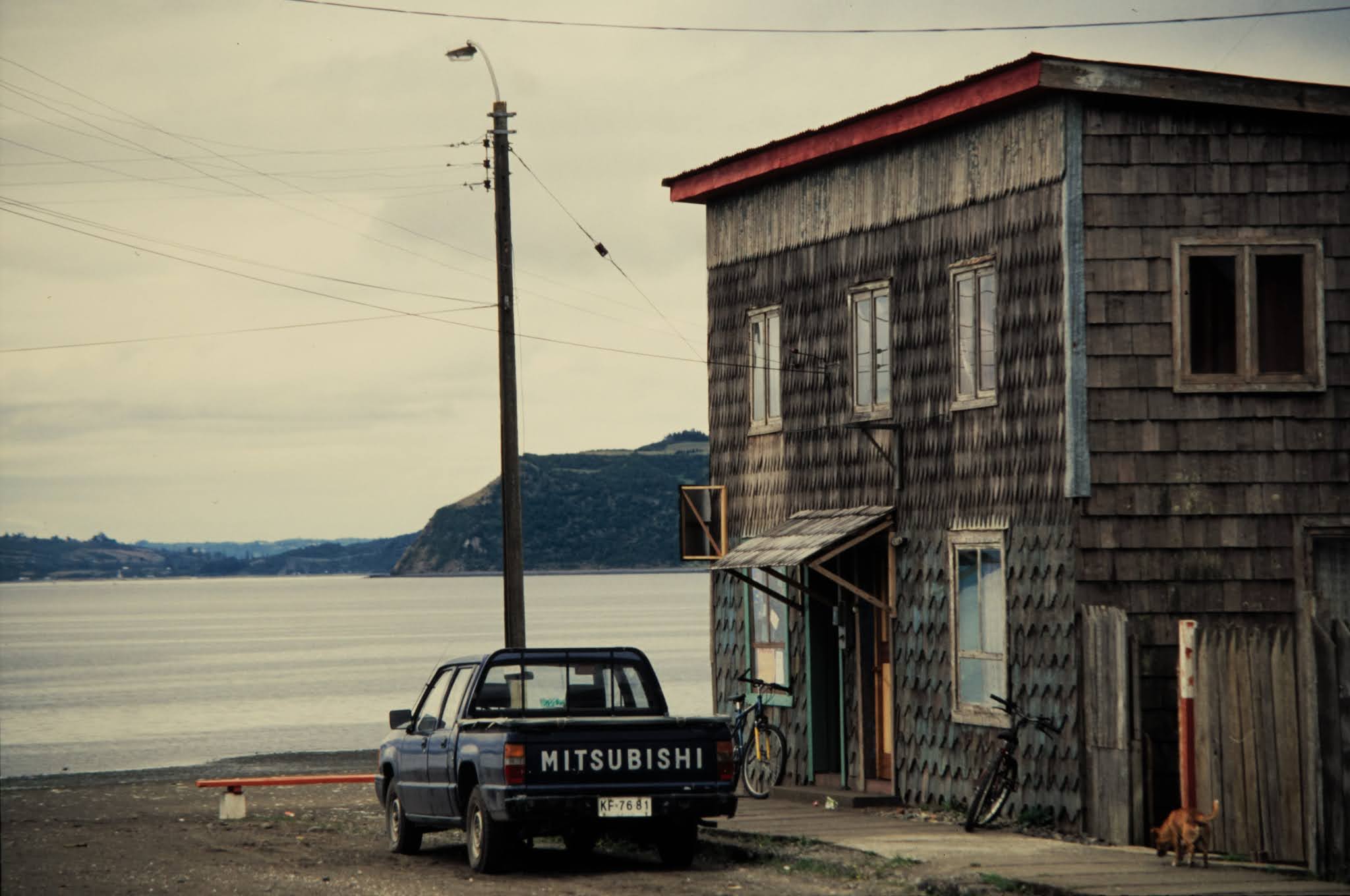
Traditional wooden buildings


The german bakery - there were several waves of german immigrants to Chile


When I arrive in Castro on January 17th 1998 I am a bit disappointed. Besides the churches the island is famous for the palafitos, wooden buildings on poles above the mud of the shore. The palafitos of Castro were in a deplorable state. A spanish group of architects – arquitectos sin limites - was busy with the reconstruction of a group of buildings, the remainder looked rundown. Entire blocks have been replaced by a desolate concrete shopping mall. Next to the mall was a game arcade with table soccer. A steam engine made in Germany is the last remainder of the narrow gauge railway to Ancud, which was washed away in 1960. A sign on a locomobil on display tells that the machine was helping in the destruction of the forest on the island. Part of the forest were Alerce Andino trees, the south american variation of the Sequoia, mammoth trees sometimes several thousands of years old and with very strong, long-lasting wood. Chiloé was the main producer of railroad ties for the whole continent. Today the alerce is all but gone on Chiloé. The television broadcasted about furniture produced in Puerto Montt made of the wood of alerce andino roots and the remains of trees found in the ground.


Esta ciudad
cientos de cables amarrandola
vigilada por luces y mas luces
trasladada desde el dia hasta la noche
en un paso y otro siempre gritando

This city
hundreds of cables tying it
watched by lights and more lights
moved from day to night
in one step and another always screaming

x.c., (poetry from murals in Castro)


The palafito restaurant with television and view

The fish market in the harbor sells sea urchins and a variety of shell fish. I ask for the names of the mussels, but each time I asked I got another name. The island also is famous for the lcal food, and the palafito restaurant where I have dinner serves sea urchin soup. The view across the bay from the restaurant at sunset is spectacular. There are only a few guests although it is the main tourist season. Maybe they stay away because the television blasts continuously? The news talks of an inexplicable apparition on a mountain top in northern Chile. I buy a bottle of wine and finish it off in my room in the guesthouse with a view over the little harbor. The next morning at the opulent and endless breakfast the lovely owners apologize for the noise of some drunkards at night. They had called the police, but, probably thanks to the wine, I had slept really well and did not hear a thing.


The wooden church of Castro

I go to the main square to rent a bicycle. A tour group is already waiting. The owners of the shop are late. When they eventually arrive they have an extensive smell of alcohol. They had to spend the night in the prison cell, thanks to my hosts. The tour guide offers to take me and bicycle along in their van to Conchi. After a long delay we eventually leave.


Road to Conchi

The little town of Conchi has much more atmosphere than Castro. Palafitos line the shore and there are a couple of blocks of wooden shingle buildings above. Cycling is surprisingly exhausting with the constant ups and downs on the quiet country side roads. But I am rewarded with views across shiny blue bays. White buoys indicate the main source of income – salmon farming. Above the green rolling hills the snow covered tops of the volcanoes of the chilean mainland hover in mid air.


Bay near Conchi, the white clouds are actually volcanoes on the main land

All the villages on the way have their pretty wooden church, enormous in size for the few people living there. Many overlook the waters of the bay: Teupa, Conchi, San Antonio de Padua de Vilipulli, la iglesia de Nercon, San Francisco de Castro. In Vilipulli, the big church serves a mere handful of houses. The other villages are not much bigger. They had to make good use of all that wood…


The church of Conchi

Chile is part of the Pacific ring of fire and earthquakes or Tsunamis are frequent. On May 22th 1960 an earthquake of scale 8.6 on the Richter scale occurred off the coast of South Central Chile. The earthquake triggered a Pacific-wide Tsunami with a wave as high as 25 m. On Hawaii, 11000 km away,  61 people were killed. Most lives were lost and damage was done along the Chilean coast between Concepion and the southern tip of the island of Chiloé. After the earthquake and in fear of more shocks, the islanders had taken to their boats. When the tsunami arrived 10-15 min after the earthquake, all the boats were lost. Low lying buildings were destroyed. Palafitos only survived in protected bays. The estimates of the number of victims vary widely between 330 and 2000.


The church of Teupa, the shed has since disappeared 


The church of Quinchao

Hay quienes construyen muros para poder vivir en paz. Hay quienes lo hacen por diversion.
Pero yo los hago para no oir los gritos desde lejos

There are those who build walls to be able to live in peace. There are those who do it for fun.
But I do them so I don't hear the screams from afar

(Cesar Jaramillo)


The church of Nercon


The church of Villipuli

Most of the settlements on Chiloé are on the east side of the island. The west coast is mainly untouched. The reason for that is the ferocious weather. While the eastern part is protected, the west coast is open to the pacific ocean. Since it is so sparsely populated it was easy to turn some of the land in the western part of the island into a national park. A hiking trail leads along the seaboard of the park. I buy provisions for a couple of days and left part of my luggage with my hosts to go to the park the other morning.


The next morning it rains. The owner of the hospedaje recommends to postpone my hike. When it rains in Castro, it will be even worse at the west coast. However, the weather in Chiloé and in particular on the west coast is unpredictable anyway. It might rain this morning but be fine in the afternoon. Or rain for the next week. When I insist on leaving, the good man offers me his fire brigade helmet for protection. The thing has about the weight of my whole packed back-bag. Under their worried looks I shuffle off during the rain to the bus station.


Hike along the beach - sunshine on the way back


The rain does not stop at the bus station and only gets worse during the bus ride of one and half hours to the other side of the island at Cucao. Everything seems to be flooded here. I stop at a ranger station but they don’t seem to worry about a hike into the national park. Two chileans have left before me but I will never meet them again. The track is in a gully. For some support they have put boards and branches on the bottom of the path. But the branches are about 30 cm under water. It quickly seeps into the boots from above. Walking along the higher edges of the gully is even more difficult. With drenched feet in soaked boots I arrive at the beach. But the track along the beach is not much better. The wind from the north is so strong that I hardly make any progress. I walk in shorts. Since I am soaked from top to toe it does not really matter what you wear anyway. Finally I get to a hill and stumble up a steep path covered in deep mud.


There are a couple of huts up there, but I do not see anybody. Below on the other side is a beautiful wild beach covered in low hanging rain clouds. I have to get down there but how? I try a path but it ends in the thicket. “Don’t panic” is the most important advice of “the hitchhiker’s guide to the universe”, one of my favorite books at the time. I stumble back up again and finally find a soaked path down. It ends at a creek. Some soul with good intentions has laid some logs into the water for crossing but the creek is swollen to such an extent that I have to wade through the water. It doesn’t really matter since everything is already wet.


I curse as ceaseless as the rain and continue along the beach. The rangers have said something about a refuge but I cannot see anything. To top it all something seems to have broken at my back-bag. Eventually I spot one of the typical campsite bench-tables. I leave my back bag behind and go on exploration. In the low scrubs along a beautiful beach I find some campsites, a primitive hut which supposedly is the refugio Cole Cole and a tent with an Argentinian from Mendoza. He seems to be worried that his peace is disturbed by other arrivals but I guess the rain has scared everybody else away.


All the beaches on the west coast are wild

When you look at the area today on google maps you find a solid refugio and leafy campsites under trees. All the photos show a beautiful blue sky. In 1998 the campsites were hidden in the dense scrubs which also served as toilet. I get my back-bag and start setting up my tent after the rain ceases and is replaced by occasional showers. There is water inside the bag and even the sleeping bag is wet. I look for some wood but it is too wet to light a fire. So I prepare instant soup with my stove but it boils over and blocks the stove. While I wait in the tent for the next shower to stop I discover how to disassemble the stove and clean it. Should have done that a long time ago. Then I try to mend the back-bag but either the needle or the yarn breaks.


My tent protected by the scrub on the beach 


My second set of clothes is still dry but while wearing it I don’t dare to leave the tent in fear to be surprised by another shower. So I prepare some dinner under the fly of the tent and try to sleep. I wake up regularly because of the drumming of the rain drops of the occasional showers on the tent, the noise of the breakers on the nearby beach and the fear, that the tent breaks. The zipper bursts open occasionally under the pressure of the wind.


I stay two nights at Cole Cole and use the day to explore the path leading north. It is a doubtful pleasure to put on the wet clothes in the morning. Although it has stopped raining everything is dripping wet. In this forest every tree is a whole ecosystem giving life and space to millions of other plants living on the tree trunk and branches. Strangely enough there is one tree, the red barked Arranyan, which seems to be resistant against these guests. Its stem and branches are completely free and shine red through the thicket. The path is terrible. Part is in the bed of a creek. Other long stretches are under water. My boots, barely dry from the day before, are soon soaked again. On the way I meet the only park ranger who is busy clearing the trail. He is bored. For the whole season he lives with his señora and his little child in one of the primitive huts. There is nothing to do and the weather is horrible. But in the course of this day the showers stop, the sun comes out and it even gets warm. I spread out my gear to dry. Now, with the nicer weather, other people start to arrive. An Argentine couple invites me to a round of Mate and a chat. A guy I met before on another hike arrives and we spend the evening together at a campfire and exchange travel yarn.


The parasites on the trees in Chilé 


The red bark of the Arranyan keeps the parasites away

The next morning I try to dry my tent but each time I am almost done I am surprised by another downpour. Eventually I pack the wet tent and leave. The way back takes longer. The weather is much better and I can enjoy what I have not seen on the way in. But although it is dry now the walking is exhausting. Progress is difficult in the soft sand and it is very hot.


The beach near Cucao


Along the beach I now notice dead penguins and a dead seal. The northern part of Chiloe houses the only known common breeding area of magellanic and Humboldt penguins. A penguin, still alive, is attacked by a Carancho, or crested Caracara, a kind of falcon. Each time I come close by, the Caracara walks away and looks back over the shoulder whether I follow. Eventually he gives up and flies away. When I walk towards the penguin to take a picture from close by, it does not flee but starts stumbling towards me. After just a few steps it collapses from exhaustion. I am afraid I have spoiled the Caracara’s lunch but not significantly extended the penguins life.


The caracara and the penguin 


Exhausted penguin collapsed at my feet


Eventually I arrive at Cucau and enjoy a cold beer and kuchen - they use the german word for "cake" here - while waiting for the bus. On the way back everybody is exhausted and falls asleep. In the friendly guesthouse they already wait for me and I get back my room with the view of the harbor. It feels like coming home. The television in the restaurant tonight has one main topic: the pope is meeting Fidel Castro in Cuba. Fidel Castro in a black suit, manicured beard and tie, enthusiastically presses the hand of the pope…. my universe collapses.


The restaurant guesthouse la nave in Achao


Dark clouds at sunset after a shower in Achao


Chiloé is not just one island, but a whole archipelago. The east coast with its deep bays and fjords sports numerous little islands, many with their own big wooden church. Lanchas, little boats, ferry people and produce across the bays. To take some of that in I go to Achao, center of an island connected by a short car ferry with the “mainland“.


Boot in the streets of Achao


Lancha


Unloading of a boat at Achao


Scales for weighing the produce


Transport in Achao


One of the supermarkets


I take a room in the hosteria la nave in Achao. It is built on stilts right on the beach. The restaurant overlooks the bay and the light of the setting sun floods the room in the evening. Colorful boats lie in the mud at low tide. The little town is much more laid back than Castro. The only bar is called el progresso, but progress fortunately has still a long way to go to arrive here. But then, what defines progress anyway?  All houses are clad with the typical wooden shingles, which come in different shapes and once bright but now faded colors. Abandoned wooden boats occupy the empty spaces along the streets. A little concrete jetty forms the harbor. Boats arrive from the other islands. The main produce seems to be seaweed, which is exported to Japan. It is weighed on scales mounted to the back of a truck. Most of the transport is done with horse carts and tricycles. The few shops seem to sell only in big quantities. Large sacks of rice or noodles, boxes and crates fill the shops and block the light from the windows. Vultures sit on the roofs and look for some spill.


Horse carriage for unloading the ships


The church of Achao


Vulture on the roof of the church


The weather is splendid. From the top of the hill above the village the row of snow covered volcanoes on the mainland more than a hundred km away stick out from the blue sky. The sea is a complicated maze of bays, channels and islets in a vivid green.


A leaflet promises a big fiesta at the wooden church on one of these islands, Quehui. A french women had told me that she was so fascinated of this island that she would like to die on it. The leaflet promises performances of local music and dance groups, local food and local craft. It takes two hours in a lancha to get there from Castro. The fiesta is a bit disappointing. There are no performances and local craft, and the different food stalls all serve cordero asado. The other visitors and the locals, although friendly, look at me as if I come from another planet. The few people who talk to me are heavily intoxicated. The island is small, in one hour I have walked around it.


Fiesta in front of the church of Quehui

After more than a week I have to leave from Chiloe. I spend the last evening in another restaurant without television. They play brilliant music. I sit at the window and watch the lazy movements of the boats in the bay under the last sunlight of the day. The vultures have found a resting place on a roof, the cormorants on a boat. The wine is plenty and the food is good. The next morning the good people of the guesthouse say farewell to me like to an old friend.


The sea is always close by

As always with old memories, it is interesting to check on Google how it looks like today. The hosteria la nave in Achao looks as unchanged as the boardwalk serving as promenade along the bay. Unfortunately they have repainted the church of Castro. And of course they have built lots of development, even on the remote island of Quehui. Why has everything new always to be so ugly? Tasteless? Cheap?


The ferry to mainland Chile

el resumen de la vida
es respirar
y dejar de hacerlo

the summary of life
is to breathe
and stop doing it
r.c.


Doors and 


the typical shingles of the houses in Chiloé 


Link to the previous post