Thursday, March 25, 2021

Corona walks, number 1, Hoek van Holland


Hoek van Holland


Between 1962 and 2004 the port of Rotterdam was the world‘s busiest sea port. Even today it is only surpassed by Singapore and Shanghai. It covers an area of more than 100 square km and stretches along 41 km of the river mouth of the river Maas (Meuse). It thanks its importance to its location in the rhine meuse sheldt delta, which means that freight can be transported on ships far into central europe. Originally the main activities of the port were close to the city centre, but with the development of bigger and bigger ships and in particular the arrival of the enormous oil tankers new port areas were developed closer to the sea. In 1872 a new, deeper entrance to the port was dug, the nieuwe waterweg. That is where all the ships enter the port and it is one of the world‘s busiest shipping lanes.


The nieuwe waterweg with container terminals in the background

Along the nieuwe waterweg are enormous container terminals, the crude oil terminal and a vast terminal for landing coal and ore. But the waterway also has attracted connecting industries as prominent and visible as refineries, other chemical plants, power stations and shipyards but also less visible enterprises such as coffee roasters or the world’s biggest fruit juice distribution center.


A pilot boat leaves the harbor in Hoek van Holland 


This device measures the height of the water depending on the tides


The headquarters of the sea rescue brigade 


The few remaining old sailor's homes in Hoek van Holland


In one of the basins in the port of Hoek van Holland the speedboats ferrying the pilots to the incoming behemoths are waiting. At the next pier a fast ferry, a quick water bus connecting the different remote outer parts of the harbour. This is a cheap and easy way to make a port cruise since the ferry passes the container terminals, ore cargo port and refineries in this part of the harbor. This port is also the home of the angels of the sea, the life saving brigade, which has the headquarters here   


When the first container ship arrived in Rotterdam in 1966 it carried 226 containers. Todays behemoths are as long as 400 m and carry up to 20.000 containers. The day before yesterday one got stuck in the Suez Canal, the canal is blocked and all the traffic mainly between Asia and Europe interrupted

Nice about the harbor entrance of Rotterdam is that most of the newly developed industrial areas are south of the mouth of the waterway, whereas the northern part is either residential or has only small, historic port facilities. Right north at the mouth is the little town of Hoek van Holland. It developed only after the nieuwe waterweg was dug and was never an independent town, but soon became a suburb of Rotterdam. As a port Hoek van Holland has a ferry connection to Harwich in England and used to serve as terminal for the ocean liners of the Holland America line. A railroad was built to connect it to the station of Rotterdam, and the station of Hoek van Holland has seen international trains running as far as Berlin, Warsaw and even Moscow. With the increasing popularity of air travel those international trains have disappeared and the line is now a part of the metro in Rotterdam and does not even connect any more to Rotterdam central station. The enormous station building in Hoek van Holland is a shadow of its former glory.


A metro train in the old station of Hoek van Holland, which has seen international trains going as far as Moscow


A walk along the waterway from the town centre to the sea gives the chance to observe all the ships going in and out. Signs warns the pedestrians of sudden waves spilling on the walkway from passing ships. Even now, during a so called corona lock-down, ship-spotting is a popular pastime and numerous people sit in the spring sunshine and wait for what is going to come.


The fortress built in 1881 now is a museum


The storage facility for torpedoes built in 1881 now is a restaurant


German WWII artillery bunker. The device in the foreground is a paravane. It cuts the anchor cable of sea mines

Due to its importance the entrance of the port was heavily fortified. In 1881, a new fort was built to defend the harbour entrance. When the Germans invaded the Netherlands this fort was the departure point of the Dutch royal family to their exile in England. At the same time a torpedo storage was built, which today is converted into a restaurant. In WWII the fortress was reinforced by the Germans. Hoek van Holland was declared a „Festung“. In total 343 bomb resistant bunkers were built, most of which still dot the surroundings of the town. The original fort of 1881 and a collection of bunkers along the waterway were turned into musea and can be visited. When they reopen again…. 


The former german soldier's club, now a restaurant 

But the Germans also have built an ammunition bunker behind the first hundred meters of scrub. Next to it the former German soldiers club, which today is turned into a restaurant. With its overhanging roof the architecture reminds a bit of an alpine hut in Austria. In the backyard there still is an enormous water storage bunker.   


Beach houses next to the port entrance


The beach north of Hoek van Holland


The promenade along the waterway is prone to flooding by waves from passing ships


The pier protecting the port entrance from the current


One of the big container ships leaves one of the container terminals


Already at the end of the 19th century, Hoek van Holland developed as a sea side resort. The railway was extended to the beach, where also the metro will end when it is finally finished. Fancy beach houses were built close to the harbour entrance, where the vacationers not only have a short walk for a dip into the sea, but also get a good view of all the ships, a good smell in their noses of all the chemical industry and a constant hum in the ear from the conveyor belts of the ore terminal across the water. Even though it is low season and the numbers of new infections in the Rijnmond area around Rotterdam was never as high as yesterday, almost all these beach houses are occupied. I talk to a couple of people sitting at their garden tables in the sand of the beach downing their first bottle of white wine. They live close by, in Dordrecht, but still rent one of the houses occasionally in low season to get a change of scenery. I also hear quite a bit of german and english words, another sign that the corona measures are unsuitable to deter anybody from moving.


Deserted beach club in Hoek van Holland

At the terminus of the future metro line is the commercial centre of the beach. The beach bars, which, on a sunny day, are full of activity, are deserted. The tables, chairs and stretchers are piled up and covered with dust. By order of the government they have to stay closed. However, the takeaway snack places are booming. The customers sit together in the public spaces between the closed enterprises and devour their purchases. A group of motorcyclists stand together and discuss their machines standing at the edge of the sandy beach. Only the people entering one of the takeaways wear a face mask.


The commercial center of the beach

A bit further up are the old-fashioned beach houses, where bunk beds, a kitchen, bathroom and tiny living room are packed into an optimised tiny house space. A couple of workers is busy preparing them for the first customers. Already here, only few steps away from the activity of the takeaways the beach is empty. Walking is difficult in the soft sand, so visitors prefer to stay at the water line or on the concrete walkway connecting the beach houses.


Old fashioned tiny beach houses


The dunes behind the beach


entrance to one of the big parking lots


Behind the beach stretches a wide area of scrub covered dunes hiding numerous of the bunkers, not only of german but also of dutch and American cold war origin. The dunes also hide enormous parking lots. The size of the parking lots gives an idea what is going on here on a nice summer day. One, especially for motorhomes. The parking lots are empty even for a day during the week. Again, there are some German license plates. According to the current rules these people have to register online before they return home and go in quarantine which they can reduce when they test negative after five days….


Bunkers in the dunes. They are now an important home for bats


Behind the dunes is one of the poshest residential areas of Rotterdam with reed covered turn of the century villas behind high walls with extensive gardens. As long as the trees are leafless the villas can be inspected without obstruction. There are few people and no visitors here, although this area is as scenic as the port entrance and the beach.


One of the posh villas close to the beach

A nice hike of a couple of hours includes a walk from the station along the shipping lane and a couple of impressive fortresses to the pier which widely stretches out into the sea and protects the harbour entrance from the currents along the British Channel. Signs warn the hiker of the waves caused by the big ships moving past. If you continue hiking along the beach in summer, you can take a dip. Then return across the dunes with more hidden bunkers and parks with hidden villas to the town centre.


The forest hides another assembly of fortifications and tunnels

On the way home i am stuck in an enormous traffic jam. Including myself these are all the people who supposedly work from home or stay at home due to the corona lock-down.....

Monday, March 15, 2021

Corona stories, number 61 France 1992

Les Bonhommes


Traditionally the French Mediterranean coast is one of Europe’s most popular summer retreats. Millions of vacationers go there for their beach vacation and in July and August it can get incredibly busy. The magnificent walled city of Carcasonne turns into a terrible tourist trap once you are inside. The traffic jam around the lovely medieval port of Collioure is so terrible that it is better to abandon the car and take one of the infrequent trains into town. However, outside the high season the weather is still pleasant and it is far less crowded.


The charming town of Collioure was a favorite hangout of artists

The vacation feeling on parts of the coast and the mostly unoccupied mansions of the super-rich along the grande bleue are in stark contrast to the poverty of some of the population in particular immigrants mostly from former French colonies in the Maghreb and central Africa. Parts of Marseille, Nice, Narbonne or Montpellier look more like busy bazaar neighborhoods in Tunisia, Algeria or Morocco. There is little integration of these mostly Muslim immigrants and it is not really surprising that poverty and despair lead to radicalism. As a consequence the grande bleue has been part of the frontier in the war the Islamic state has declared on the Christian world. How this is supposed to improve their fate is unclear.


Abandoned village in the massif centrale

In September 1992 I had the pleasure to attend a French course at the university of the lovely town of Montpellier. I went there by car. After a most enjoyable number of days of crossing the whole massif centrale from north to south I arrived on the parking lot of the part of the university where the course was to take place. The participants stayed in the student accommodation on the campus. I grabbed my back-pack and went to the reception desk to register and get the key. Waiting with me was a guy in swimming shorts, slippers, a t-shirt and a plastic shopping bag. I made a remark about his light outfit and luggage. He told me that he had, before registering, spent the morning on the beach and when he came back to his car a window had been smashed and all his luggage was gone. What he was wearing and what he had in the plastic bag was what he had bought to not arrive at the campus in only the swimming trunks and bath towel.


One of the typical fragile looking bridges

The university had issued warnings to beware of thieves. They advised to keep doors locked at all times, remove everything from parked cars and avoid walking at night with valuables. I was a bit concerned since I had arrived in a brand new car. I took the ignition cable off and left the doors of the car open. Nothing happened during the stay of three weeks.


However, the poor chap in the swimming trunks was followed by his bad luck. His car, open since the back window was broken, was stolen after a couple of days.


In 1992 the R4, one of the characteristic french cars, was still a common sight

In the weekends I took my camping gear and my ignition cable and went on road trips. Next to the scenic landscape of the southern rim of the massif centrale the area called the Languedoc Roussillon has a wealth of historic landmarks like monasteries, medieval towns and villages and castles. The latter a consequence of a violent history.


The right middle image of the tympanum of the cathedral of Bourges shows what will happen to the infidel and sinner at the last judgment

The south of France has a long tradition of conflicts between people of colliding faiths. What changed from time to time was the definition who the infidels were. In 732, Karel Martell stopped the advance of the Umayyad Caliphate led by Abdul Rahman Al Ghafiqi, Governor of al-Andalus in the battle of Tours. But although in the following centuries the Moors were driven back into Spain and finally had to leave Europe, the plague of frequent attacks of pirates ransacking the French Mediterranean coast stayed.


Cathedral Saint Cecile de Albi towers above the medieval town


However, the departure of the Moors did not prevent the Christian world from their own, internal religious war. Although they existed allover Europe, in the 12th to 13th century the community of the Cathars had become especially strong in south western France. Originally they were called Albigenser after the town of Albi, where they had many supporters and next to Toulouse, Carcassonne and Agen one of their bishops. The Cathars denied the shameless self-enrichment practiced by the catholic church. They rejected church taxes, but also dogmas and sacraments like baptism, marriage, confession and the eucharist. Starting point for their ideology was the dualism of good and evil. The good god ruled over the invisible world while the visible world was the creation of Satan. On earth, men were imprisoned in their bodies. Salvation was only possible by consolamentum, laying the hand on the head of the moribund. The soul was relieved from the body to allow it to return to heaven to avoid another detention in a different mortal body. These Bonhommes spent celibate, vegetarian lives doing public good to become Parfaits. The parfaits proclaimed strict pacifism.


The city walls of Saint-Guilhem-le-Désert stretch right up to the fortress on the crest


The pilgrims church of St Guilhem and the market square


The ideology of the cathars was a thorn in the side of pope Innozenz III. In 1208 he announced a crusade and an army under the leadership of Simon de Montfort started moving south from Lyon in 1209. The pope got support from the French king who for a long time had resented the independence of the rulers in the south. In July 1209 Simon de Montfort appeared at the gates of the city of Beziers and demanded to hand over 222 cathars. However, the catholics in the town supported the cathars and refused. 

The cathedral of Bezier above the Orb river


On July 21st 1209 the crusaders entered the poorly defended city through the open gates. At the time the city had a population of 10.000-14.500. Some of them might have left before the attack. The invaders plundered the city, set fire on the houses while many of the inhabitants, cathars and catholics alike, took shelter in the churches, in particular the cathedral de Saint Nazaire. However, the churches were not suitable refuges. The crusaders broke the doors open and killed who was inside while


Reports that the massacre of Beziers caused 20000 victims are probably exaggerated. But even the more real number of 7000 is quite shocking. The town was destroyed to such a degree that the invaders left right after the victory. The cathedral burned down. It took until 1215 until the repairs started. 


Inside the cathedral of Beziers


The cloister  of the cathedral was never completely rebuilt.


From Beziers, the crusaders moved on to Carcassonne and Toulouse. Even the death of Simon de Montfort, who was killed by a stone hurled from the walls of Toulouse by a woman, did not stop them. Count Raymond VI of Toulouse supported the case of the Cathars, but yielded when facing the enemies’ army, to protect his own case. Nevertheless even in 1235 the magistrate of the town was still able to expel the inquisition. 

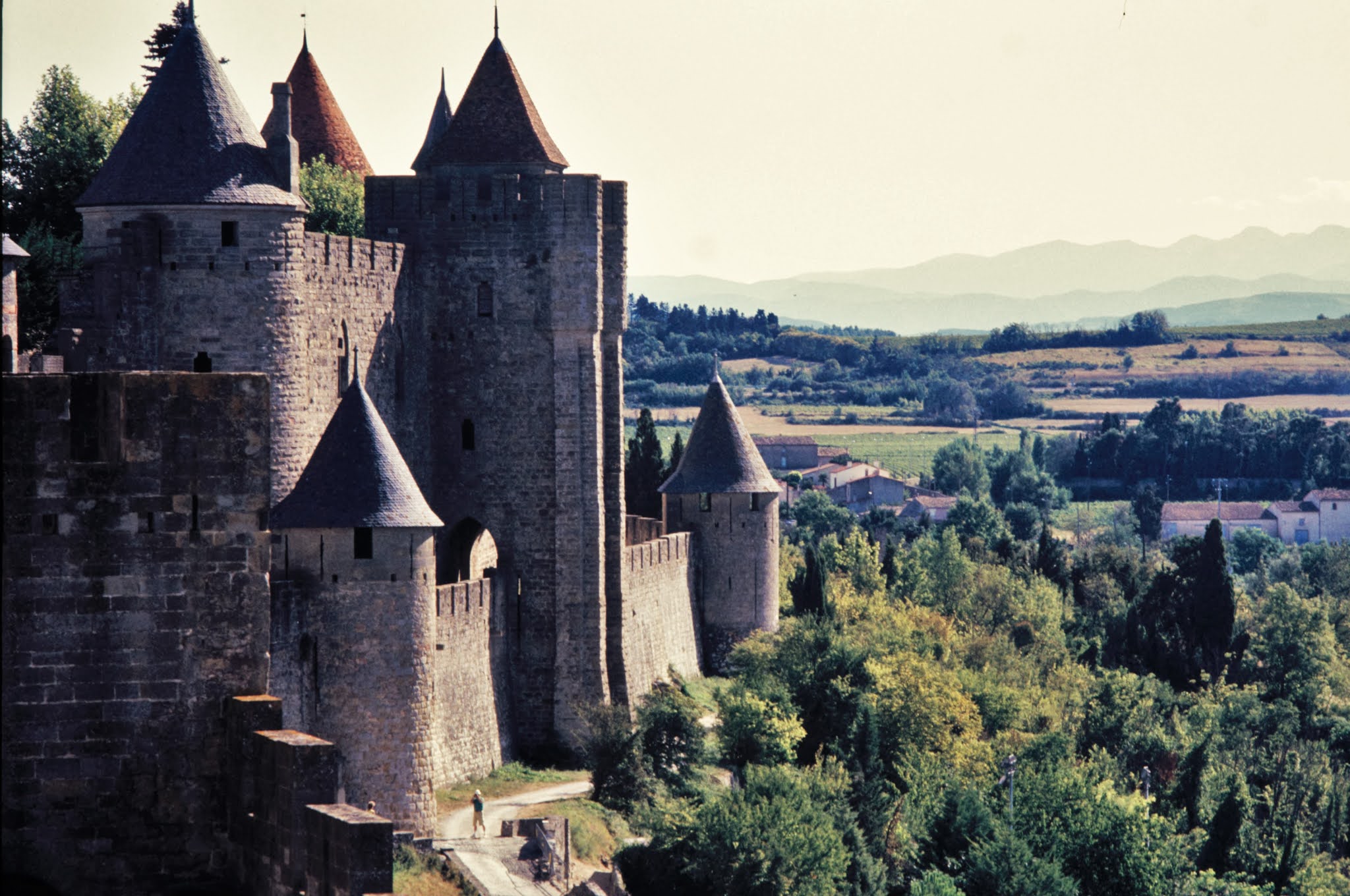
The impressive ramparts of Carcassonne hide the tourist trap in the interior


The palm tree vaulting of the church of the Jacobins in Toulouse was finished at the end of the 13th century,  after the Cathars 


Meanwhile the Cathars had retreated to a string of remote mountain fortresses and villages between Carcassonne and what now is the Spanish border. Most of these fortresses still exist, however, only small parts actually date back to the time of the Cathars. Most were rebuilt to serve as border fortification against the Spanish kingdom of Aragon. What they all have in common is that they are perched in an impossible position on rugged mountain ridges. Impressive Peyrepertuse was abandoned already in 1209 without a fight since the occupants did not have provisions. The two strongholds closeby did not last much longer. The oldest part of Puilaurens dates back to the 11th century. Neighboring Puivert mainly dates back to the 13-14th centuries. Many Cathars retreated to the castle of Monsegur, high up at 1207 m in the foothills of the Pyrenees. Finally Montsegur fell in March 1244. 200 of its inhabitants ended up on the pyre. However, the Cathars still held out secretly in some places. The last castle they occupied until 1255 was Queribus. However, secretly they survived in some of the hidden villages. One of them was the village of Montaillou. Eventually the inquisition got notice of what was going on. Detailed 14th century records of the ensuing investigations are preserved. The historian and writer Le Roy Ladurie has retold the history in his book Montaillou, Cathars and Catholics in a French village, 1294-1324.


Entrance to the gorge de Galamus on the route de pays cathare


A touristic route, les routes de pays cathare, links the different sites between Beziers and the spanish border in the Pyrenees. Many of the Bonhommes fled across the mountains to what at the time was the kingdom of Aragon, where they felt safer. While passing the string of mountain fortresses the route also takes in some remarkable natural sites. One is gorge de Galamus, where the road is hacked into the vertical cliffs on one side of a narrow valley. There is not enough space for two lanes. Fortunately there is little traffic in September and thirty years ago it was no problem to make frequent stops and take in the view without blocking the traffic. From time to time I pass historic bridges which look so fragile that it is a miracle they did not yet collapse. I stayed at the municipal camp grounds and sometimes was the only guest.


The fortress of Queribus was the last stronghold of the Cathars


Even more than in other european countries the countryside in France runs empty. Many of the farms too small to make a living were abandoned and the buildings in ruins. In some of the villages most of the houses are empty. I visit friends who have bought a house in a remote valley in the Cevennes. The only houses still in use have been bought by people like my friends from faraway as a summer retreat and DIY pastime. The only permanent occupants in their valley is a gay couple with a child in the village at the end of the road. The loss of permanent residents has led to the loss of infrastructure and shops. What is left has to live from tourism. In the village of Montsegur at the base of the castle the population has dropped from once around 1000 to 125. Butcher, bakery and vegetable shop have disappeared. In winter when there are no tourists most of what is left shuts down as well.


The castle of Montsegur 


View down on the village of Montsegur, where 200 Cathars ended on the pyre


On sunday evenings I returned back to University for the classes. The rooms in the students home were basic and a bit run-down. The locks were solid but not entirely trustworthy. A skilled burglar would know how to deal with them and there were traces of repairs of previous attempts on some doors. But there was a little hotel safe inside the room. Unfortunately it was too small for my camera equipment. Since it was no option to leave anything in the car I left the camera in the garbage bin under the garbage bag. Nobody broke into my room and I didn’t loose anything during my stay.


The castle of Puylaurens

One, pretty, girl had a bit of a problem. Every night somebody came to her door, demanded her to open and whispered obscenities. At a certain point we learned about her problem. I recommended a visit to the gendarmerie. But some tough guys among the other participants of the course were more in favor of direct action. The next night when the guy scratched at the girl’s door, the door opened. But he did not have a very romantic welcome. The guy never came back and was never seen around the campus any more.


The fortress of Peyrepertuse is visible from far away


In the time of the Cathars Peyrepertuse was an entire town on the crest of the mountain


We spent most of the evenings in a bar or brasserie in town and had fun, however, without big success of trying out our newly acquired language knowledge on the local girls. Against all the warnings I usually walked the long way back to the campus and hardly never saw anybody. Obviously everybody else in Montpellier observed the warnings against going out at night. Except of one of those tough guys. One morning he did not appear for the lesson. After some inquiries it turned out that he had been arrested by the police. It took a couple of days until he was released and we learned about what had happened. He had started walking back to university in the middle of the night when a car stopped next to him and asked whether he wanted to have a ride. He got into the back seat and noticed that the back window was missing. After the guys had taken off, a police car appeared from behind and they made for a run. When they tried to cross a roundabout the direct way the car got stuck. The two guys in the front seat got out and fled on foot. The tough guy could not get out fast enough from his back seat and the police got him. The car was stolen. In fact it was the car stolen from the unlucky guy in the swimming trunks. Of course the police thought that our mate was the accomplice of the two guys who got away and probably participated in stealing the car. He did not have an ID on him and their interest was mainly in finding out the names of his companions in the car. Eventually they got the confirmation from the university that they were missing somebody and released him.


The charming castle of Puivert


Like most of the others it was rebuilt after the Cathars were gone


The next religious turmoil came to France with the Reformation. However, with the edict of Nantes, Henry VI guaranteed religious liberty to his protestant subjects, the Huguenots, in 1598. For a while, religious unrest in France was settled. However, already in 1685 the Edict was renounced by Ludwig XIV in the edict of Fontainbleau. Many Huguenots left the country. Since they frequently were skilled artisans they were welcome in other countries. Rulers in Prussia and other protestant parts of Germany and Denmark invited them to settle and cities were especially found for them (see Corona story number 57, https://h-s-coronastories.blogspot.com/2021/02/number-57-germany-2010.html). A good example in history how refugees can be a useful complement and integrate into an existing society.


Entrance to the cathedral of Montpellier

The medieval atmosphere of the time of the Cathars in the 13th century is well captured in Henri Gougaud’s historic novel Belibaste. Guilhem Bélibaste is an inhabitant from Corbières, a Cathar and a simple and honest man. Being threatened with being handed over to the inquisition he murders a man. Bélibaste is an anti-hero, a Cathar "parfait" and a martyr in spite of himself.


Still the favorite pastime in the south of France: jeu du boules


Link to the previous post


Other link regarding Beziers:

Sources: