Sunday, November 15, 2020

Number 45 Italy 1985


Cosa Nostra 


When you think of Sicily you think of Mafia. When we decided to go cycling in Sicily in 1985 my travelling experience of Italy was restricted to some trips as kids with my parents to the beaches of the Adria and Riviera in the North and a couple of short trips on my own to Venice. Further south the country was considered to be in the hands of corrupt politicians, pickpockets, robbers and in particular criminal associations like the Mafia in Sicily or the Camorra in Napels. While we still selected Sicily I do not remember, but since it was begin of April we probably expected better weather than further north. 

“the origins of the mafia are closely related to the origins of an untrustworthy state-the Italian state” (John Dickie) 


Postings referring to a barbaric mafia massacre


In 1979, the Mafia clan of the Corleonesi under the leadership of Luciano Leggio and his lieutenant Totò Riina had started to attack anyone who would not comply with their needs. Politicians, journalists, magistrates or policemen were murdered. After April 1981, the war was extended onto other clans of the sicilian mafia with the goal of a Mafia domination. It became known as the second Mafia war. Within two years, hundreds of mafiosi along with women, children, relatives and friends had been murdered. The scenarios of all the well known mafia movies became reality. 

“Men were shot in public places or strangled in deserted cabins, their bodies dissolved in acid, dropped in the sea, buried in concrete or fed to pigs.” (John Dickie) 


We preferred more this advertisement poster 

Law enforcement was frustrated. There was no help from politicians and witnesses remained silent. That is when Palermo magistrates Paolo Borsellino and Giovanni Falcone entered the scene. In 1984 Tommaso Buscetta was extradicted from Brazil to Italy. That had happened before, since Bruscetta had served an eight years sentence in italian prisons before taking refuge from the second Mafia war in Brazil after undergoing plastic surgery and an operation on his vocal cords. But while in Brazil before 1984, the Mafia murdered two of Bruscetta‘s sons, his brother, his son in law, brother in law and 4 nephews. Bruscetta was frustrated with the Mafia and decided to cooperate with the cops. Others followed. Falcone and Borsellino had their case. 

“the mafia kills in the way a state does; it does not murder, it executes.” (John Dickie) 


Starting the cycling tour south of Messina

We only had a vague idea of that situation when we arrived by night train at the strait of Messina to take the ferry to Sicily and pick up our bikes at the station. And the bicycles were there, undamaged. On the train we had met another German chap, who also picked up his bicycle in Messina. However, he preferred to tour the Island counter clockwise. His next destination was Palermo. Our first destination was the antique town of Taormina, a trip of 50 km along the coast. We thought we would meet him again. And we did. And he was not the only surprise encounter on this trip. 


Sicilian countryside road in spring

The town centre of Taormina is quite a way up. Therefore we rang at the door bell of a hotel between the main road, the railway and the sea. They told us the hotel was still closed but when we would not mind to dispense with breakfast or dinner we could get a room. They already had guests staying under that condition. It turned out that before April 15th many places in the seaside resorts were still closed. 


Etna smoking as backdrop to the antique amphitheater of Taormina 

In 1985 the green party in Germany was just five years old but already had won seats in the federal parliament and in 1985 started to participate in the first state government. Our fellow guests were founding members of the party in Berlin who had escaped from their party’s ideological civil war to Sicily in an old VW camping bus. The other guest was a young german teacher who immediately got my undivided attention. 


In the streets of Taormina

We originally had had the intention to carry on from Taormina after one night but we had such a great time the night of our arrival that we decided to stay. After we came back from a bit of sightseeing the next day our fellow guests announced that they would go to Syracusa the next day in their bus and that we were welcome to join. So we did not only stay a second, but also a third very pleasant night. The following morning my friend threatened to carry on alone on his bike if I would intend to stay another night. Reluctantly I joined him and with a heavy head from the long nights before we got on the bikes again. 

The old harbor in Syracusa

We only had ordinary bicycles with 3 gears and with luggage the mountain road around the Etna was challenging. The narrow road crosses numerous lava flows, sometimes crystallised in the typical hexagonal columns. We had heard the worst about italian, and in particular sizilian drivers. However, there was little traffic, and everybody was very careful with us. Cars usually stayed behind us until there was a save spot to pass or we pulled off the road. 


Lava flow behind the Etna

Finally we reached the town of Adrano and found a simple room for the night. When we had dinner in a cheap pizzeria in the evening, suddenly an untouched bottle of grappa appeared on the table. When we told the waiter that this must be a misunderstanding and that we didn’t order it, he pointed at a guy at the table in another corner of the room. He wanted to invite us for a couple of drinks. It turned out that the man spoke perfect german because he had worked as a migrant worker in Germany. Apparently he had had a good time there and was happy to meet us and refresh his memory. We emptied the bottle with him, again not the best prerequisite for the next day’s cycling. 


The norman castle in the town center of Adrano


Our next destination was the town of Enna in the centre of Sicily. Like the neighbouring town of Calascibetta Enna sits high on a plateau of a mountain with steep slopes. It is Italy’s highest provincial capital. It is also called the belvedere or the ombelico (navel) of Sicily. However, apart from the beautiful vistas, the town gave a somber impression. The narrow streets were lined with dark buildings. There is a spectacular castle, a couple of other remnants of defensive buildings and a lot of churches, the biggest of which is the cathedral. 


In the streets of Enna


View from Enna across the valley to the next town of Calascibetta


We arrived in Enna before Easter. This is the time of the processions of the confraternities. In a climax on Holy Friday hooded men, delegations from different neighbourhoods, carry the statue of Jesus from the cathedral and the statue of Mary from the Church of Sant Antonio to the cemetery in a more than 3 km long procession. In the gloomy town the hooded men in their Kukluxclan like attire and the mournful songs gave a spooky impression. The many posters warning against the Mafia added to the feeling. However, the custom relates back to the time of Spanish occupation of Sicily. 


The good friday procession in Enna


South of Enna is the town of Piazza Armerina. We went there to visit the roman villa. However, the town was a sight by itself. Most of the beautiful baroque buildings in the town centre were in ruins. Roofs and windows were lacking or broken. Trees and weeds were sprouting from the walls. Even the counterbalance weight of a construction crane had grown weeds. Obviously it had not been used for quite a while. 


Piazza Armerina


This construction crane was not moved for a while


We had taken the bus and left our bicycles at the base of the mountain of Enna. In a little bag on my bike I had left a sandwich and a soft drink package. Somebody had searched the bag, eaten the sandwich, drunk the soft drink and had nicely left the empty bags folded up on the luggage rack of the bike. That was the only case of theft we had to endure while in Sicily. 


One of the temples of Agrigento

From Enna we continued to the south coast to the classical archaeological sites near the towns of Agrigento and further on along the south coast to Selinunte. Sicily had been one of the most important greek colonies and the temples in these sites are some of the best preserved anywhere. However, the towns were gloomy, dirty and frequently surrounded by a belt of skeletons of half finished constructions and of - sometimes burning - garbage. A big part of the road leading west was built on stilts, in our view completely unnecessary since the terrain is not very difficult. There was hardly any traffic. 


Burning garbage and construction ruins surrounding some of the towns

On a little road between Agrigento and Selinunte the first cyclist we had seen since Messina came towards us. We both waved at him while he passed. Suddenly I heard him shouting my name from behind. It turned out that it was one of my best friends, who was busy to cycle around the island counter clockwise. 


Old and new roads in Sicily


Via Sciaccia, Marsala and Erice we finally arrived in Palermo. In my faded memory Palermo is one of the most beautiful baroque towns in Europe. However, in 1985 it was completely run down. Houses were black and sometimes supported with beams or scaffolds on the street side. After sunset there was practically nobody in the street. The few cars rounded the street corners with screeching tires. Walking on the sidewalk was outright dangerous because people tended to throw their garbage bags down from windows into the streets in the hope that somebody would collect the spread out mess. We rented an almost empty room in a vast family appartment. We found few places open for dinner at night. Finally we ended up in a pizzeria. After dinner, the owner insisted to drive us home even so it was only a couple of blocks since he thought that walking at night was far too dangerous. We became his regular customers while in Palermo. 


The town center of Palermo


Wrecks in the harbor of Palermo


In a parc in Palermo


The next day we saw somebody who looked familiar. It was the other german cyclist whom we had met on arrival in Messina. We were a bit surprised that he had only come as far as Palermo in the time while we had rounded almost the entire island. After he had arrived in Palermo, he had toured the town on his loaded bike with the headphones of his walkman on his head looking for a place to stay. A narrow street was blocked by a truck. When he stopped a couple of guys wanted to take his walkman. He resisted. Eventually they took the walkman, his bike, his luggage, his watch and his jacket. He was left with the rest of his clothes on his body. With his luggage he had lost all his money, his train ticket and his passport and now was still waiting for a money transfer from Germany and a replacement passport to be able to return home. 


Mummified bodies in Palermo's famous underground cemetery

Although nothing comparable had happened to us I was glad that my mother had sewn a hidden pocket into my pants where I kept my passport, ticket and most of my money. 


The norman cattedrale de Monreale outside Palermo is one of the most spectacular churches in Europe. Its ornate cloisters and bright gold mosaics of biblical stories are unique. We were the only visitors. 


The cloister of Montreale cathedral


After WWII more than 14,000 people were homeless in Palermo due to the destruction by Allied bombing. There was a huge demand for new homes and construction was subsidized by public money. However, Palermo's Office of Public Works was infiltrated by the Mafia. Between 1959 and 1963, about 80 percent of building permits were given to just five people, none of major construction firms, probably Mafia frontmen. Other construction companies not related to the Mafia were forced to pay protection money. Many buildings were illegally constructed and Mafiosi intimidated anyone who questioned the dubious building activities. Many historic buildings were demolished and the new apartment blocks were of bad quality. 


“The barons’ power on the ground was such that the central state’s courts and policemen could be pressurized into doing what the local lord wanted. Worse still, it was now no longer only the barons who felt they had the right to use force. Violence became ‘democratized’” (John Dickie) 


The second Mafia war had shown that the Mafia was not an honourable organisation in the track of Robin Hood but a blood-thirsty killing machine. Wikipedia has a list of Mafia victims dating back to 1893. While we were in Sicily, on April 2nd 1985 Barbara Asta and her two little twins were killed in a car bomb intended for the anti-mafia investigating magistrate Carlo Palermo. High ranking police officers were killed on July 28th and August 6th. On December 12th Graziella Campagna, a 17-year-old girl, found a list of names of mafiosi inside a coat at the laundromat where she worked. She gave it to her Carabinieri brother. Shortly after, she was killed by five blasts of a shotgun. However, 1985 also was the year when the efforts of the duo of Falcone and Borsellino started to have success. Eventually 475 Mafiosi were imprisoned in a newly built steel concrete bunker with cage like cells. In February 1986 the Maxi process started and eventually, in 1987, 338 were convicted. It was the biggest trial in world history. 

“Cosa Nostra has, for a generation at least, been more weapon than enemy of the byzantine Italian state” (Ed Vulliamy in a guardian review of Dickie's book) 


The Mafia had connections and friends in high places. The famous movie “Il Divo” of Paolo Sorrentino hints at the connection of Italy’s powerful former prime minister Guilio Andreotti with the Mafia. Consequently there were appeals against the convictions in the Maxi process, and a decree of Supreme Court Judge Corrada Carnevale resulted in the release of many of the convicted Mafiosi. However, after Giovanni Falcone joined the ministry of Justice in Rome, the convictions of the Maxi trial were confirmed and the Mafiosi finally put behind bars, where they still remain today. 

“Rather than being a ‘ship of state’, Italy often seems more like a flotilla of boats, each piloted according to a different chart, each competing for access to the most favourable winds, yet each afraid of being isolated from the other craft” (John Dickie) 


The catholic church still plays an important role in Sicily


The Mafia took revenge. Both Giovanni Falcone and his friend Paolo Borsellino were assassinated in 1992 by Mafia bombings. They resorted to terror to destabilise the Italian state and frighten politicians. A series of bombing of tourist attractions went so far that a bomb seriously damaged the Uffizi gallery in Florence. 

“The world has changed but the Sicilian mafia has merely adapted; it is today what it has been since it was born: a sworn secret society that pursues power and money by cultivating the art of killing people and getting away with it” (John Dickie) 


And the Mafia is still there. In Sicilian it costs the economy more than €10 billion a year since around 70% of Sicilian businesses are forced to pay protection money. The Mafia is still active in drug trafficking, gambling, smuggling of immigrants, extortion and frauds by vote buying in elections. In 2018 alone almost 100 people were arrested because of suspected Mafia activities. 


These old men on the liar's bench probably would have had a lot of stories to tell

In his book “Cosa Nostra: A History of the Sicilian Mafia" John Dickie recounts the rise of the mafia in Sicily as consequence of a weak state after the italian unification in the 19th century and their rising power, readiness for violence and rules of conduct. The book tries to put an end to the fable of nobleness created by Hollywood actors and directors and brings the Mafia back to what it is: a pitiless criminal organization. 


The previous post can be found here 

Sunday, November 8, 2020

Number 44 USA 1989-2020

Upheaval 


When I arrived in the USA for the second time in the summer of 1989 there was a new president. H.W. Bush, the senior, had won the election on November 8th the year before. He had been vice president under Ronald Reagan and ran for presidency against the democratic candidate Michael Doukakis. Although Doukakis’ seemed to have quite good chances at first he lost very clearly with 45.6% against Bush’s 53.4%. Bush was the first sitting vice president being voted president since 1836 and was the last republican to win in the states of California, Connecticut, Delaware, Illinois, Maryland, Maine, New Jersey, and Vermont. 

Immigrants on the Beach, Virginia Beach, Virginia 2016

When we have elections in Europe, things might get exciting, but determining the winner is simple. The seats in the German parliament, the Bundestag, are basically proportional to the number of votes the parties get. Since there hardly never is an absolute majority of  >50% of the votes for one party, the strongest party has to form a coalition. When they have agreed on their program they form the government and the parliament with the majority of this coalition elects the chancellor. The chancellor is always the top candidate of the strongest party. The problem lies in the formation of the coalition, which sometimes takes a long time until a compromise between the different ideas is found. The coalition is usually formed after a program for the next legislative period was agreed on between the parties. Compromise is the basis of government. 


Symbol for the many German immigrants to the US, the Hermann Memorial in Neu Ulm, Minnesota, 2014 

“Elections are the essence of democracy. If a ….. country’s citizens can’t vote, such a country does not deserve to be called a democracy. By such standards, the US is barely half-deserving of being called a democracy” (Jared Diamond). 


Oglethorpe park, Savannah, Georgia 2016 

The citizens of the 5o United States vote for the parliament, the house of representatives, directly, but not for the president. The presidential candidate is voted in each individual state separately. To make things easier there are usually two candidates to choose from: one of the Republican and one of the Democratic Party. In principle, each of the 50 states then provides a number of electors roughly dependent on the size of the population of that state. Altogether the 50 states provide 538 electors. A candidate is voted president if he can get the votes of at least 270 electors. 


Many small countryside towns fight for survival. The entire town of Aladdin, Wyoming, pop. 26, is for sale for $ 1.5 million (2014) 


In 2008 the size of the town of Volcano, California, has increased by 3

The first problem lies in the number of electors. California has a population of around 35 million and 55 electors. North Dakota has a population of 800.000 and three electors. Therefore in California, one elector represents 625.000 citizens but in North Dakota only 260.000. At first view it seems that the votes of the poor Californians count less than those of the people of North Dakota. 


The origin of an entire new culture, Santa Cruz, California 2010


Now big parts of the West Coast are unaffordable for Hippies, Gold Beach, Oregon, 2014


Property in Beaufort, South Carolina is basically unaffordable (2016)

Once the votes are cast in a state all the electors of that state have to vote for the candidate who got the majority in that state. Hence if the Democratic candidate has won in California, he gets the votes of 55 electors, regardless whether he has won with 50% or 80% of the votes. To make it a bit more complicated, this does not apply for all the states. In Maine and Nebraska they do things differently. There, the number of electors is proportional to the votes cast for the candidates in these states. 


Autarkic living in harmony with nature: Earthship community, El Prado New Mexico 2011

Therefore the number of votes does not agree with the number of electors required to vote for their candidate. In 1988 G.W. Bush with 53.4% of the votes had 426 of the 538 electors voting for him. In the 2016 presidential elections, Hillary Clinton with 48.16% of the votes had 232 electors voting for her while Donald Trump with 46.09% had 306. Donald Trump became president even though the majority of Americans wanted Hillary Clinton. 


Homeless veteran in Beaufort, South Carolina, 2016

“The US has a long history of preventing whole groups of age-eligible citizens from registering.” (to vote at the elections) (Jared Diamond) 


Symbol for the separation of Texas from Mexico: Film set of the Alamo, Brackettville, Texas 1998  


No need for a border wall here: the Canyon of the Rio Grande, Big Bend National Park, Texas forms the border to Mexico

After antique Athens the United States had the world’s first and oldest democracy. The founding fathers had written the constitution in a time when feudalism and monarchy were the rule. At the time there were 13 states with a population of about 2.5 million. A big part of the population like women had no voting rights. 


Early settlers cabins near Lee Vining, Mono County, Calfornia, 2010


A state full of covered bridges and Victorian buildings as memorials to the early immigrants, Rutland County, Vermont, 1994

Voting had to be conducted locally since transport and communication were slow. The citizens knew their local representative who then voted for the president. A similar system forms the basis for the world’s other old democracy, Great Britain. In comparison, democracy in most other countries is rather young. When their constitution was written they could built on previous experiences, literacy and communication were widely improved and more direct voting was possible. 


The New England Coast is full of hidden coves and little harbours, with a clipper rotting away since 100 years, Maine, 1994 

Nevertheless, the system installed more than 200 years ago was surprisingly far-sighted. Even the German constitution clearly incorporates parts of the one of the USA. 


The residence of founding father and early president Thomas Jefferson, Monticello, Virginia, 2016

While Germany has a chancellor as head of the government and a president who in principle has the power to install or dismiss the chancellor, check the government and has to sign new laws, such a separation of head of government and head of state does not exist in the United States. The president is head of government and also head of state. He therefore has much more power than a German chancellor or president. 


Conquest and settlement became only possible with the construction of an extensive railway network, Nevada Northern Railway, Ely, Nevada, 2011 


Shed of the Cumbres and Toltec Railroad in Chama, New Mexico, 2011 

The American constitution like those of most democracies is based on the principle of checks and balances which mirrors the suspicion and insecurity the authors had in view of their new laws and the people being in charge. While one house of the congress, the house of representatives, represents the proportional number of voters, the party of the president does not necessarily have the majority. A president who was only voted with low margins therefore can be checked to see that he does not overlook the needs of a strong minority of oppositional voters. The system also insures that the states have a certain influence on the selection and politics of the president by giving a higher importance to the votes of the smaller states. In case the different institutions have different majorities compromise is also indispensable in the american system.  


New Orleans, Lousiana, 1998, before Katrina swept it away

The second check is the senate. Each state sends two representatives to the senate. The 100 members are elected for 6 years. Only one third of the Senators is elected at a time by the voters of their states. Every two years there are elections for another third. When the president’s party has no majority, the senate can check what the president is doing and block decisions. The vice president is the president of the senate and has a decisive role when there are no majorities. Since a third of the senate can be voted out of office in a two year term the power of an incapable president could in theory be quickly restricted. 


The railways were replaced by gasoline boozing monsters, Cortez, Colorado, 2011

It seems to be unjust that every state sends the same number of 2 senators to the senate. However, this can be seen as another check against the overpowering weight of big, populous states against little or sparsely populated ones. 


Access road to the Navajo Indian Reservation, Monument Valley, Arizona 2011


A lonely hilltop school serves the children of faraway farms, Pasco-Kahlotus road, Washington 2014


US 6 near Warm Springs, Nevada, 2011

Germany is like the United States a federal Republic. The part of the parliament corresponding to the senate is the Bundesrat. However, the members of the Bundesrat are not directly voted. The members of the Bundesrat are sent by the states. More populous states send more representatives. The state of Bavaria with 12 million inhabitants sends 6 representatives, the city state of Hamburg with a bit more than 1 million sends 4. Like in the Senate of the United States, therefore, participation in the Bundesrat is not entirely proportional to the number of people in a state. Party affiliation is a reflection of the parties in the respective government of the state. Parties not represented in the government of the states don’t get a seat in the Bundesrat. While in the US the composition of the Senate can change with every round of elections for the senators, the composition of the german Bundesrat only changes indirectly when the government of a german state would change during the legislative period of the federal government. Task of the Bundesrat is to approve the laws the government has had approved by the parliament, the Bundestag. The Bundesrat also has the right to raise a veto against those decisions. The function of the Bundesrat therefore is comparable to the US Senate. However, this system might disadvantage smaller states like the city states or the less populous eastern former states of the GDR, which have a much smaller population than the original states of western federal republic before reunification. 


Disappeared ancient civilizations, Mesa Verde, Colorado 2011


The famous pueblo of Taos was inhabited until recently, New Mexico, 2011

The German head of state is the Bundespräsident. He is elected for a maximum of two five year periods by a special convention put together by the members of the Bundestag, the federal parliament, and the same number of electors nominated by the state parliaments. Compared to the president of the United States he is not part of the government. He has a mediating function in case of conflict and will demand compromise. He proposes or can dismiss the chancellor, dismiss the Bundestag, declare state of emergency but mostly signs all laws which passed Bundestag and Bundesrat, although he also has the right of veto. The American President fulfills the function of German Chancellor and President in one person. 


Route 66 is everywhere in the American West, US 6, Tonopah, Nevada, 2011


US 95, Hanksville, Utah, 2011


Grain elevator, Main street, US 14, Midland, South Dakota, 2014


Grain elevator, US 14, Greybull, Wyoming, 2014


In his book “Upheaval” Jared Diamond analyses how nations cope with crises and change. The German constitution of 1949 was a consequence of the failure of the constitution of the Weimar Republic, which was not able to avoid the catastrophic takeover of power of fascism. But the book also analyses why the United States, regardless of a number of geographic, scientific, political and economic advantages, face big problems in the future. 


One of the world's leading centers of science and culture, Boston, Massachusetts 1994 

“There is no way that China or Mexico can destroy the US. Only we Americans can destroy ourselves” (Jared Diamond) 


The most revered presidents are honored at Mount Rushmore, South Dakota, 2014  

Jared Diamond sees the biggest danger for the United States in the absence of compromise. The German parliamentary system would be destined to failure if the parties, none of which has the chance to govern alone, would not work together. If there was a gridlock the two biggest parties formed a coalition to solve the problem. In his book Diamond shows a photo, in which you see republican president Ronald Reagan, for sure not the most compliant of the bunch, stands smiling and embracing the democratic speaker of the house Tip O’Neill. That is inconceivable in the present administration, but things were getting tougher beforehand. Short messages without expectation of reply have replaced discussions. Incitement and spreading of rumors have replaced logical reasoning and detailed information. Maybe compromise more easily gets lost in a two party system. Similar tendencies are visible in British politics. 

That is the most important, but not the only point he wants to make. 


Dog house B&B, Route 95, Idaho 2014

When elections are upcoming in Germany we get a card in our post box some weeks before and with that card we can either apply for voting by mail or go to the polling station on election day. Without the card no vote. You have to hand in your card to receive the mail voting sheets. Without it you would not be able to show up on election day for another, in person vote. In the polling stations, on election day, sometimes there are a couple of people ahead, but even then it is a matter of minutes. American friends of mine had to stand in line for 2,5 hours to finally be able to vote in Virginia. 


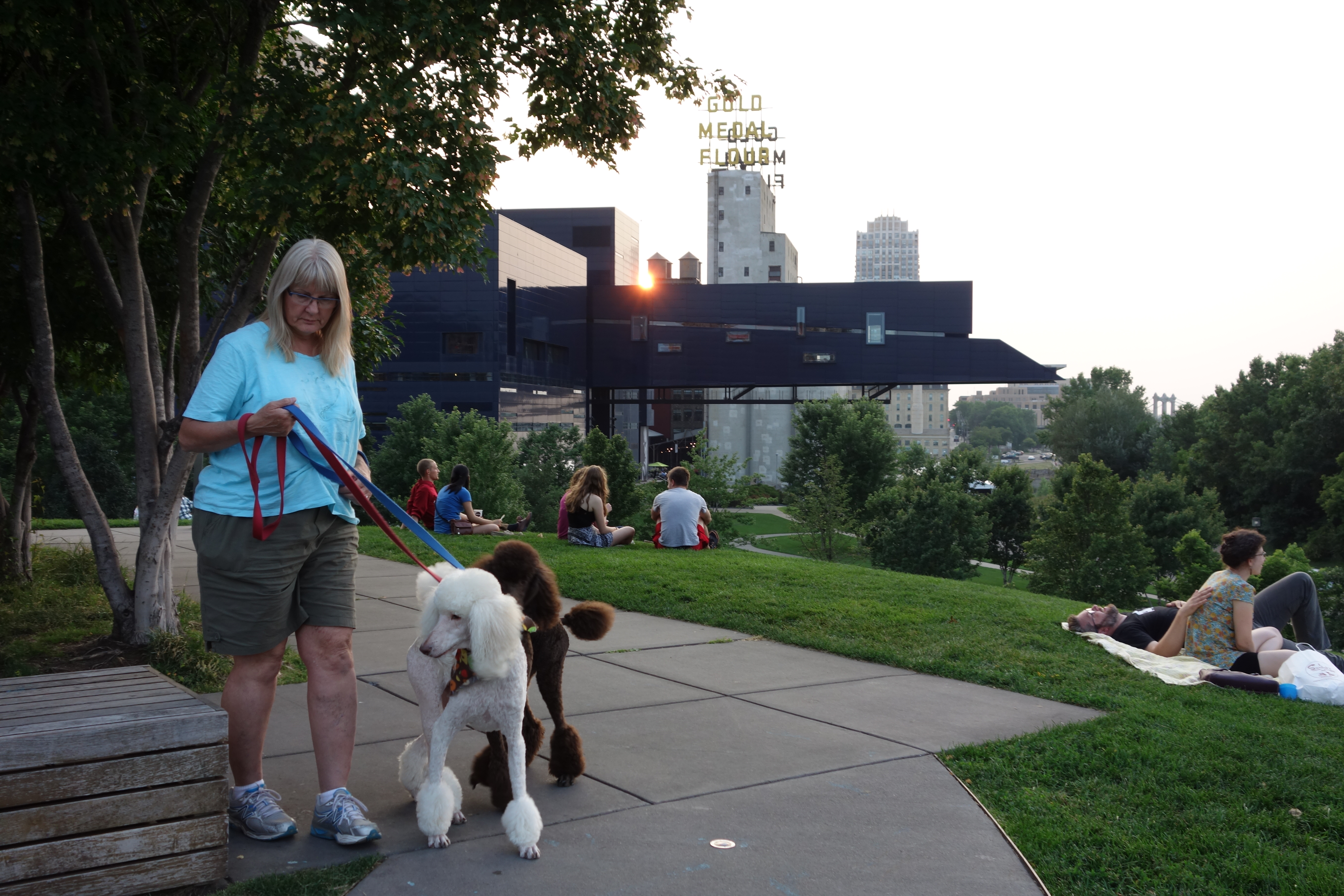
Dog lover, Minneapolis, Minnesota, 2014 


Dog lover, Portland Union station, Oregon, 2014

Voting registration in the US is not straightforward. Parts of the population have no access to a picture ID and therefore have no right to vote. It is not surprising that these are the poor parts of the population. Criminals or ex-criminals have no right to vote. Consequently the participation at elections in the United States is continuously low. Even in this years election the turn-up of 67% was much lower than usually in any elections of a European state. Giving parts of the citizens the impression that their vote is not important or even excluding them can only lead to frustration. 

Park Ranger, Bodie state park, California, 2010

A for me fascinating and unique US topic is the role of so-called “Gerrymandering”. The name comes from Governor Elbridge Gerry of Massachusetts, who already is 1812 redrew the borders of the congressional districts to increase the number of electors of his party. “Mandering“ comes from salamander and that refers to the weird shape some of these redrawn districts have. Some are not even a continuous area or not much wider than a highway. This practice gives the ruling party an inadequate advantage over the opposition. Nevertheless it was declared legal by the supreme court. Diamonds book shows some maps of such gerrymandered election districts.


Park ranger, Castillo de San Marcos Natinal Monument, San Agustin, Florida 2016

This year‘s elections have cost the candidates an amount of around 16 billion. The point is not that this amount is spent, but its consequences. Elected candidates get dependent on their sponsors. Fund raising becomes a task which consumes more time than actual governing. But in addition non-affluent but capable candidates are unable to run for elections. In fact, the division in rich rulers and on average poor and powerless citizens is a reflection of a society, where the three richest men (Jeff Bezos, Warren Buffett and Bill Gates) have a combined net worth equaling that of 130 million of the poorest Americans. In my view, that is not the fault of Jeff Bezos, Warren Buffett and Bill Gates. It is the fault of american politics that 130 million people are poor.


Living like the sun king: Biltmore, the estate of the Vanderbilts, Ashville, North Carolina, 2016

The question is not who wins an election but what happens afterwards. Every winner should include the loosing party and take their views into account in his policies. A politician who publicly announces to categorically refuse to compromise and to block any decision regardless of the topic is unripe to take part in politics. If he would be a manager in a company his attitude would be regarded as counterproductive and he would be immediately fired. The voters as employers of the politicians should take such an attitude into consideration.
 

Henry Flagler was an industrialist, the founder of Standard Oil, Miami and Palm Beach. His enormous hotel tops over San Agustin, Florida, 2016

“The United States enjoys enormous advantages. But countries can squander advantages, as has Argentina. There are warning signs that the US may be squandering their advantages today”(Jared Diamond) 


The industrialization came and went, leaving behind ghosts, Butte, Montana 2014

In 1913, Argentina was the world’s 10th wealthiest state per capita. Argentina had and still has ample natural resources and a well educated population. Argentina didn’t and doesn’t have external enemies. The squandering of the wealth of the nation was entirely due to political mismanagement which eventually led that rich nation into repeated bankruptcy, hyperinflation, economic and political failure and eventually disastrous dictatorship. 


Gun shops are everywhere in rural United States, even in a hotel, in case you did not sleep well, Greybull, Wyoming, 2014

link to the previous post