Against all odds.....

„Life is subversive“ Ernesto Cardenal
I like to prepare my trips well, know about the history, environment and the manners of a country. Likewise it is interesting to look up more information about the places visited after a trip. This of course is much easier now, in times of internet, then in 1994, where you had to visit libraries and find the suitable books to get more information.
Between 1854 and now, Nicaragua had 26 presidents. This does not sound so bad, since each on average would have served more than 6 years. However, the picture is different if you count the periods of government including juntas, presidents who had a comeback, and acting leaders, who ruled, but where no president. Then you count 55. If you then subtract Daniel Ortega, who rules this county now for almost 19 years and additional 5 years as leader of the junta of national reconstruction (sic), you arrive at the conclusion that a government on average lasted about 2,5 years. There are very few who ruled more than 4 years, and many who ruled less than half a year. At the time when we came to Nicaragua, the president was Violeta Chamorro. She was the leader of the Unión Nacional Opositora (UNO), a coalition formed to replace previous president, leader of the guerilla against the dictator Somoza, and leader of the sandinista party (FSLN), Daniel Ortega. he ruled for 6 years and 260 days. I have kept a newspaper article from the time which analzsis her incompetence and corruption.
„Todo hombre es poeta. Olvidan hacer versos porque se dedican a hacer otras cosas, hacer dinero, por ejemplo“
(Every man is a poet. They forget to make verses because they dedicate themselves to doing other things, making money, for example)"
(Ernesto Cardenal)

Daniel Ortega, leader of the FSLN, in front of his troops
We went to the nicaraguan embassy in Tegucicalpa, Honduras, to apply for a visa. There they readily issued a visa, but asked us how we intended to travel in the country. There was a strike of unlimited duration. The sandinistas, who not surprisingly disagreed with the politics of the joined opposition, blocked all traffic. There were no busses and no private transportation. We still had to go. My friend Thomas had a flight back from Managua to Europe, and I wanted to continue south to Costa Rica.

FSLN propaganda
To get as far as possible in a day we left from Tegucicalpa on the first bus. When we arrived at the border close to a settlement with the misleading name „el paraiso“, the border guard examined our passports with a worried look. Then he came up with the same story. We were allowed to enter the country, but he was afraid that we would not get very far. Then he pointed at a VW bus. The driver would go south in the direction of Esteli, the next major town, and maybe he would take us. So we walked up to the bus and asked. He declined. The Sandinistas had established road blocks at the border of each town. If they would find him breaking the strike rules, they would smash his windows and punch his tyres.

The bus at the first road block behind the border
Obviously we looked very miserable, so he wanted to be kind and continued the conversation by asking us where we came from. He started to think when he learned that we were from Germany. „A lot of people from your country came to help us when we had the revolution. I have an idea. I try to help you“.
So we threw our backbags in the bus and took off. Only a short distance behind the border we had to stop at the end of a long line of vehicules. The first road block. That could take hours. Our driver got out and went up to one of the wild looking guys patrolling the line of cars. They looked at us, then the guy nodded and they walked away to the begin of the the road block. After a while our driver came back, started the engine and passed all the cars. The road block consisted of two trucks with a metal chain inbetween. Before the chain a sign: one car per hour, one truck in two hours, a bus in 5 hours. A very well organised strike. The guards lowered the chain and we were allowed to pass. Our driver had told the Sandinistas that we were German development workers who had to go to Managua to help the people of Nicaragua.

The enemy was clearly defined

„ Slogan-making is not poetry“ (Ernesto Cardenal)

One of the road blocks
When we arrived in the next town, he left us at the road block. We walked to the other end of town, where we spotted a school bus leaving slowly. We started to run, backbags and all. The school bus did not stop, neither accelerate, but they opened the door in the back, which all these american school buses have, lowered a ladder and we jumped on the slowly moving vehicule.
In this way we got to the town of Esteli, where we spent the night in a lovely hotel with a beautiful inner courtyard. It is called hotel Arcor and it still exists. We were the only guests.

Intermediate stop in a roadside pub
The next day, at the road block at the southern end of Esteli, we walked right up to the guys guarding the barricade. They asked us where we wanted to go. Then they walked along the line of cars. After they had found somebody who wanted to take us to Leon, our destination for the day, he was allowed to jump the line. In that way, we had a ride and the driver did not have to wait.

The trip continues on the back of a pick up truck

Fellow lucky people who got a spot on a pick-up truck

This basically was the way we travelled for almost a week through Nicaragua. It worked very well. Nobody wanted any payment from us and we were much faster then by bus, which stops frequently or waits for additional passengers. And there were very few busses anyway. Afterwards the strike and the road blockage were lifted.

Waiting for the next lift

Fellow travellers
Like a lot of other latin american countries the permanent political turmoil in Nicaragua has produced a long list of brilliant and well-known writers. Think of Ruben Dario, Giaconda Belli, Karly Gaitán Morales and Ernesto Cardenal. The latter is symbolic for the recent nicaraguan history. Born in 1925, he became a marxist, priest and as such a fervent supporter of the sandinista movement. Like his Chilean contemporary Pablo Neruda, he had to flee from dictatorship to neighboring Costa Rica. After the fall of the dictator Somoza, he became very disappointed at how the sandinistas and Daniel Ortega ruled the country. Now, after more than 23 years of his presidency, there is still no sign of „reconstrucion nacional“. Nicaragua is still one of the poorest countries in the world. Ernesto Cardenal died on March 1st, 2020 at age 95. The funeral ceremony in the catredral of Managua was disrupted by supporters of Ortega and and had to be continued in secrecy elsewhere.
„La juventud debería ser para los viejos, porque sólo uno estando viejo sabía aprovechar la juventud.”
(Youth should be for the old, because only one being old knew how to take advantage of youth)
(Ernesto Cardenal)

Stop in the center of a village
"I am not interested in an economic liberation of man without the liberation of the whole man" (Ernesto Cardenal)

Typical means of transport in the countryside in Nicaragua in 1994

Street vendors catering for travellers in the back of a truck

Girl selling soft drinks and ice

Little boys selling drinks and sweets at a bus station
"Se dice que una de las curas del amor, de las pocas curas, son los viajes"
(It is said that one of the cures for love, one of the few cures, is travel.)
Ernesto Cardenal)

In the streets of Leon

"pensaba que tal vez era cierto que estaba loco y creía que no lo estaba porque los que están locos creen que no están locos,"
(I thought maybe it was true that I was crazy and I believed that I wasn't because those who are crazy believe that they are not crazy)
(Ernesto Cardenal)

Horse carts instead of taxis where the typical means of transport in the bigger cities

Waiting for the next transport job

Local bus

"Un nicaragüense no se siente verdaderamente nicaragüense si no ha viajado. Aunque sea a Costa Rica. El nicaragüense adquiere su verdadera nacionalidad hasta que ha viajado"
(A Nicaraguan doesn't truly feel Nicaraguan unless he or she has traveled, even to Costa Rica. Nicaraguans acquire their true nationality only after traveling.)
(Ernesto Cardenal)

People come together in front of the houses to enjoy the evening breeze
"We turn outward, attracted by the beauty we see in created things without realizing that they are only a reflection of the real beauty."
(We turn outward, attracted by the beauty we see in created things without realizing that they are only a reflection of the real beauty.)
(Ernesto Cardenal)

Market in Leon

One of the few cafes in Leon. When we had milkshakes on the terrace boys asked for the empty glasses to lick out the remainders of our drink

The civil war left a lot of ruins in Leon. Many were still not rebuilt in 1994

Outside Leon was a military fortress, which was used by the thugs of Somoza as torture center for political prisoners. When we asked directions nobody wanted to hear about it

The ramparts of the fortress. The backdrop are formed by the volcanoes around Leon

The torture cellar in the former prison


Also Granada is overlooked by a volcano

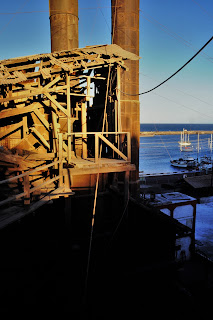
The remainders of the train station of Granada is close to the big lake Cocibolca in the center of Nicaragua. It has not seen a train for a long time


While we were in Granada we spent our evenings drinking rum and coke on the pier and watching the unloading of the boats

The railroad led to a pier. In the port of Granada boats from the islands in the lake are unloaded, here with bananas
While we were in Granada we spent our evenings drinking rum and coke on the pier and watching the unloading of the boats
"Volveré con un poco de lodo en los zapatos / y una palabra alegre que decirte"
(I'll come back with a little mud on my shoes / and a happy word to say to you)
(Ernesto Cardenal)