For many years patagonian Cerro Torre was the top of desire and controversy among mountain climbers. At an elevation of 3128 m it is not particularly high. However, the top is crowned by an overhanging icecap, which makes the ascent almost impossible. In addition the strong winds and sudden temperature changes typical for that region give only very short spells of continuously good weather suitable enough to climb the mountain.
Cerro Torre is not the highest peak in the area. Neighboring Cerro Fitz Roy peaks at 3405 m. Although climbing Fitz Roy is listed as “ultra” it is not associated with such myths as Cerro Torre and was first climbed in 1952.
Torre and Fitz Roy border the southern patagonian ice field, with 12300 sqkm the world’s second largest outside the arctic, the world’s third biggest reservoir of fresh water and also features the Brüggen or Pio XI glacier, with 66 km the world’s forth longest. Big parts of the ice field are either uncharted or inaccessible. In Chile the glaciers calve into the fjords of southern Patagonia, which due to their brute climate of continuous rain are more or less uninhabited. In Argentina the glaciers mostly end in some of the world’s most scenic lakes in the patagonian pampa and their water ends up in the Atlantic Ocean. The area is protected by National Parks Bernardo O’Higgins and Torres del Paine in Chile and Los Glaciares in Argentina. With more than 7200 sqkm the latter is enormous (but compare that to the 44.000 sqkm of the Namib-Naukluft National Park in Namibia). 30% is covered by ice. Its best known feature is the Perito Moreno Glacier close to Calafate. Unlike many this glacier is not retreating. It ends at Lago Argentino and its front of more than 70 m high regularly divides the lake into the Brazo Rico and the Canal de los Témpanos. Since Brazo Rico has no outlet the waters built up until the pressure is so high that the ice barrier breaks in a spectacular rupture which sends a Tsunami of icy water across Lago Argentino and into Rio Santa Cruz, its outlet into the Atlantic Ocean. 2004 the dammed water reached a height of more than 10 m and the resulting rupture of the ice dam was watched by 10.000 tourists.
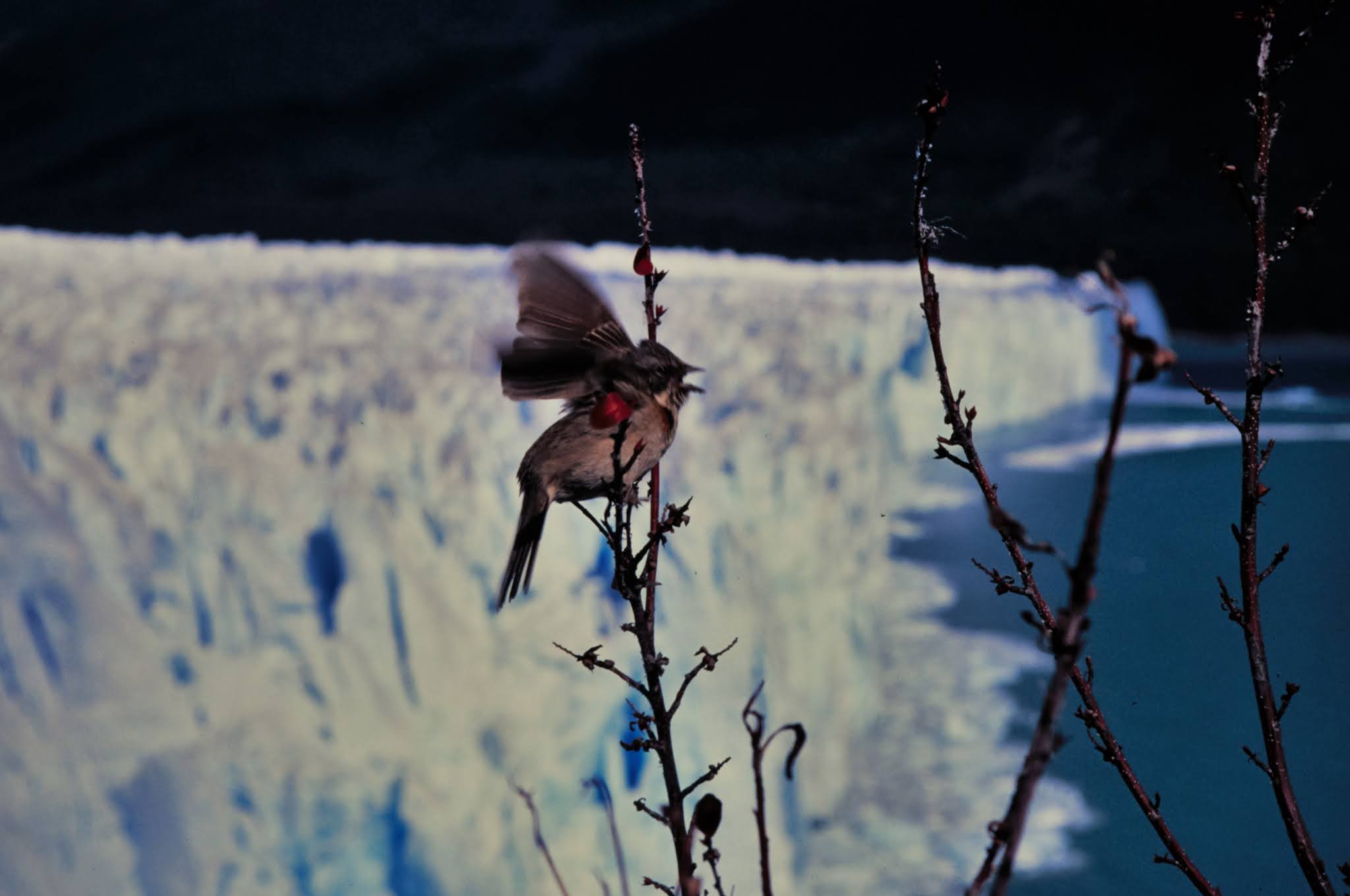
But even when the ice dam does not break this glacier is magic. All kinds of sounds reach us while we stand on a platform facing the ice mass. The glacier seems to be alive, HE sighs, grumbles and moans. From time to time big junks fall down from the front into the lake. Spectators start betting which Ice tower will be the next to fall. Big chunks create a little Tsunami racing across the lake. The power of the impact is so forceful that icy splinters fly a long way. A sign warns about not to get too close. 32 people have died from falling ice in the last 20 years. Little birds fly from twig to twig in the scrubs around the platform. Even after several hours people regret that they already have to leave the spectacle.
While Perito Moreno in the southern part of the park is an area of brief sightseeing for (now Chinese) tour groups, the northern part is a paradise for hikers. In 1997 the starting point for such hiking trips, the village of El Chaiten, still was a rather remote place only reachable after 100 km on a dirt road. There is a bus which rumbles over the dirt along bare sandstone cliffs and through endless barren pampa, always with the surreal turquoise waters of the huge Lago Argentino or Lago Viedma topped by glaciers in the background. At a place called La Leona the bus stops for Lunch. An inhabited and three ruined barracks, a pick-up and a couple of wind-swept trees, that’s all. Here the road to El Chaiten branches off. A friendly lady serves us coffee. They have a game to entertain the bored guests. A ring is suspended on a rope from the ceiling. On a board on the wall is a hook, aim for the ring. I do not even manage to hit the board. The bus driver, who is here more frequently, only needs a couple of tries to get the ring on the hook. The only other attraction is a machine with two rolls to press the water out of the laundry.

The turquoise waters of Lago Argentino
Cars are so rare on this road that everybody stops if something looks irregular. The bus stops next to a car with an open hood. Everybody gets out. The wind is so strong that I am barely able to hold my camera steady. Since the air rises at daytime when the patagonian plain warms up there is strong wind from the mountains most of the year. The bus driver gives a jerry can of water to the car driver and does a little repair job on the bus, then we continue.
The road towards El Chaiten
Help for a stranded car
On 21th of December 1997 we reach El Chaiten with back-bags full of camping gear, 2 portions of argentine and 1 of dutch freeze dried food, apples, carrots, peanuts, 3 onions, garlic, 3 cans of tomato puree, cans of corned beaf, tuna and sardines, pasta for 4 days, ready made pasta sauce, chocolate, corn flakes, 4 whole salami sausages, tea, Tang, sugar, coffee and milk powder, and plenty of fuel (Tang is powdered lemonade). It is only a 3 hour walk climbing up 200 m to the base camp of Cerro Torre. But it is unusually hot for this area even in summer. There are two campsites. One is permanently occupied by climbers who wait for the right moment to climb the mountain. We meet an italian guy who is here since begin December. He supports a group who have tried the climb and have made it to 200 m below the summit. Two Germans have succeeded and 4 Spaniards are busy at the moment. We are a bit embarrassed of being tired from 3 hours of walking with a back-bag.
The trail to Laguna Torre
Dinner preparations
The climbing history of Cerro Torre has its thrills. In 1959 Cesare Maestri claimed that he had reached the top with his companion Toni Egger. After returning alone, Maestri declared that Egger was swept away by an avalanche on the descend and with him their camera with photos as evidence of them reaching the summit. The camera was never found and neither was there any evidence of bolts, ropes or other material left on the route Maestri pretended to have taken. Toni Egger was immortalized by giving his name to neighboring 2685 m Torre Egger.
Cerro Torre in the mist
In 1970 Maestri came back and his group made another attempt with the help of a gas powered compression drill. They reached the ice mushroom 100 m below the top, fixed the compression drill to the last bolts and returned back down stating that the icy top was not part of the mountain. Maestri was much criticized for his unfair methods. He was clearly obsessed. The route he took was later baptized the „compressor route“. Other groups were criticized of unfair means like a multitude of bolts some times in spots where they hindered fair climbers. In 1973 australian climber Kevin Carroll and american Steven Mc Andrews died from rockfall on their way down. Although they were seen on a ridge to the top, it is unsure whether they reached it. Eventually a team of four other Italian climbers reached the top in 1974.
Cerro Torre, Glaciar Grande and Laguna Torre
The unfair ascent by Maestri was the focus of the book „The Tower” by Kelly Cordes. The mountain featured in other books and also was the main actor in a couple of movies, the most famous and remarkable “Scream of Stone” by Werner Herzog.
Above Glaciar Grande. Torre was in clouds again the next day.
Above our campsite is Laguna Torre, a glacial lake. Above the lake is the dirty terminus of the glacier below Cerro Torre. But the mountain itself is in clouds. For a long time we sit at the lake and enjoy the sun. There is almost no wind. And then, indeed, the clouds tear apart and the top of the Torre comes in view. It is even higher than we had expected. And covered in ice.
The trail from Laguna Torre to Los Troncos
The next two days we walk north towards a refugio, Los Troncos. We camp one night at a campground called Poincenot. We wanted to stay here for a day trip, but the second day the weather changes and it starts to rain. Hiking up to a viewpoint would not make any sense when the mountains are behind clouds. So we continue along the river. What seemed to be a flat path is annoyingly exhausting. Parts of the trail are washed away by the river. Other parts are in the river bed, where the little pebbles glide away under each step and the boots hit the bigger rocks. Eventually the trail turns into a mystic forest full of moss covered trees. After we have passed a cattle gate we have left the national park and are on the land of Ricardo, the owner of Los Troncos.
The trail along the bed of Rio Blanco
Shortly before we arrive the contours of the Valley are covered in mist and it starts raining heavily. The camp has cabañas, bunk beds in the refugio and campsites. Some of the campsites have shelters covered with plastic sheets to cook and sit without being exposed to the elements. Despite the heavy rain we decide to camp. The site is already quite full but we manage to get a spot with one of the covered shelters.
Ricardo's forest before reaching Los Troncos
The campground also features a shower, an ingenious construction where hot river water is led through an old fuel barrel which is heated by a wood fire between 6 and 10 pm. The water from the barrel is so hot that you have to mix it with a lot of freezing river water. There are also two pit toilets which are flushed with river water from a hose. Next to a BBQ spot there is also a seating area set around a Christmas tree. Tomorrow is christmas eve and Ricardo asks us whether we want to take part in the christmas dinner. Cordero asado, grilled lamb, sounds better than our freeze dried ready made food.
Refugio Los Troncos and the mountains lining the valley
It is still raining cats and dogs and so we stay in the comfortable room of the hut which is heated by an oven. There is a bookshelf with literature in a lot of languages except spanish, the walls are decorated with pictures of the mountains and old mountaineering gear. Everything is very tidy. In the hut Ricardo also offers food, and, most important, he sells beer. So we have a couple of drinks to warm up. Taking off your shoes is forbidden and in my case it definitely would not be wise since I wear the same pair of socks for about a week. Ricardo also puts on a frown when I try to spread out my wet shirt at the window. I also wore the same shirt for at least a week and probably I have got so accustomed to the smell that I do not even notice it any more.
Campground at Rio Tronco
It is still raining while we prepare our dinner. Fortunately our tent is dry. That in contrast to the tent of an american girl a bit further on which stands in a puddle of water. The girl moves into the refugio. Ricardo tells us he had expected that. He wouldn’t even dare to use that tent on a sunny day on a beach. The other guest all seem to be Italian who might have heard of Maestri.
The campground at Los Troncos with the shelters to the left
The next day shows how variable the weather can be around here. When I get up the campground is flooded in sunlight and the sky is blue. But already after a short while the mist starts moving in again and when we finally have breakfast the rain has come back. But at least I have got a short impression of the beauty of the place. Next to the campground protected by a massive monolith is a raging stream. The flat bottom of the valley is lined by steep mountains sides with water falls rushing down. A bit upriver is Lago Electrico, another glacial lake, and from there it it only a short walk to the base of glaciers flowing down from the southern ice field.
The trail from Los Troncos to the ice field
It is now the beginning of summer and there are flowers everywhere. Ricardo is utterly pleased when we ask him about some flowers and edible berries. He seems to know everything what grows and moves here and complains bitterly about his guests. Few stay for more than a night. Most run across the trails as a kind of exercise and don’t see anything. Parque de los Glaciares, seen, check off, next destination. They transfer their urban stress into this remote corner of the world. Some rent a hut for two people and then stay there with 7 others. Others come into his hut without luggage to warm up, take away the space reserved for his guests and then disappear somewhere into the woods. Because of the carelessness of the visitors there is constant danger of forest fire.
Ready for breakfast in the shelter
Meanwhile they have crucified dos corderos, which are more like fully grown rams, onto a spit with two crossbars. The spit is not turned horizontally, but speared upright into the ground next to the fire in an open fuel barrel and regularly turned around. The roasting will take most of the day. Dinner will only be ready at 9.30 pm. The sun, if there is any, sets late in these latitudes. We all stand around the fire to get a little heat. I guess this will add some more smell to my outfit. Probably the smell of woodfire is more pleasant than of sweat.
Ricardo with a cup of Mate
Meanwhile they set up makeshift tables covered in plastic sheets, plates, cutlery, salad, potato salad and wine in 10 liter containers which are later thermically recycled. Eventually the meat is ready. Everybody gets his fat dripping chunk. I have the special honor to get the testicles. In Gaucho culture they are regarded as special treat.
Cordero Asado for christmas
Meanwhile it is really cold and we move inside for cake, music and some dancing. No christmas songs. Christmas is celebrated exactly at midnight. We toast with glasses of local champagne and stumble back to our cold and humid tents.
Ricardo dancing in his hut
The next morning is dry and we hurry up to pack our tent in case another spell of rain comes down on us. Then we retrace our steps through the mystic forest to Ricardo’s cattle gate. What an idea to live in a country where you can have such a lot of land that it takes you an hour to come to your house. At the time a lot of these estancias were for sale. Breeding cattle or farming on a small scale was not profitable any more. A small scale in Patagonia means less than 20.000 ha. In Germany somebody farming on 1500 ha has a big business. Some in popular and scenic areas are bought by celebrities. During our stay Henry Kissinger was in the area to buy one but I wonder how much time he has actually spent there. Most are just abandoned or added to the estates of the neighbors.
Glaciar Piedras Blancas
The weather gets much better and so we stumble up the little valley to the glacier we had not seen before. Huge boulders are heaped up as by a giant, but this time the giant was from ice. Sometimes a part of the bolder the size of a living room has been broken away neatly. Under the boulders is a raging stream of icy melt water. We get a nice view of Glaciar Piedras Blancas with crevasses shimmering in a hue of blue. The white fractured surface of the glacier is interrupted by brown and black lines, remains of ground up boulders which slowly more downward. The glacier ends right in a little lake called Laguna Blanca. The milky surface of the lake is dotted with little icebergs.

We set up our tent in the same spot as before. It is still early and the campground almost empty. We look forward to a quiet, sunny evening when a group of three Germans appear. Noisily they set up their tent. While they chatter constantly they ignore us completely. The noise carries on until late while our neighbors take ages to prepare their dinner in their tent and spoils the atmosphere of the sunset with Cerro Torre basking in the last rays of sunlight.
Laguna Sucia and Cerro Torre
The next day we hike up to a viewpoint. Below is Laguna Sucia, a lake called dirty because a layer of ice drifts on the blue surface. On three sides the lake is surrounded by high rock cliffs. Above a hanging glacier which regularly sends down cascades of water and ice into the lake. Cerro Torre overlooks the scene from the background. Unfortunately this is not a place to enjoy a scenic view. The wind is so fierce that I have to go down on my knees to take pictures and we keep well away from the rim of the precipice in fear of being blown down. The frigid air soon has entered our whole body and so we retreat quickly.
The fall of water and ice into Laguna Sucia
While we climb back down it starts snowing while a cold milky sun still peeks through the mist. Slowly a sea of clouds invades the valleys around us while Lago Viedma in the distance still basks in sunlight. When we arrive at our tent the wind has become so forceful that it drives clouds of snow and dust down the valley. While we sit in our tent we hear the next gust of wind coming and know that it has arrived at our tent when a salvo of dust grains, snow, leaves and needles knocks at the tent wall. Dust invades the inside of the tent with every gust. Even the preparation of the freeze dried food becomes a challenge. Later it starts to snow heavily. It gets so cold in the tent that I wear long underpants inside the sleeping bag.
The view towards Lago Viedma in the background. Rain moves in from the left
While we kill the rest of the second christmas day in our tent, I ask myself why we are doing this. Why does somebody risk his life to climb Cerro Torre. Why do I sit here in a cold and windy tent with bad food while I could spend the same day on Copacapana beach and watch girls instead of ice floes. I cannot explain it but I will do it again. Finally we fall asleep. Christmas 1997 has passed.
Cerro Fity Roy in bright sunshine on the morning after Christmas
When I wake up and get out the next morning, the tent is frozen. A layer of fresh snow covers the mountains only a little above. The sun is still low and it is too cold to enjoy a pleasant breakfast. I go for a walk and climb up between the rugged trees of the forest until I get a good view of the snow covered mountains under the bright blue morning sky. Absolute silence rules. The wind has died completely. Suddenly I hear a sound in the tree next to me. When I look up, a crested caracara, an Andean bird of prey spreads its wings and takes off.
The mountains in a layer of fresh snow
The tent is not damaged but filthy all over. Also all our gear, spare clothes, sleeping bags are filthy and sticky with humidity. And I will need everything for two month more. We pack our stuff and get out of the place before the weather changes again.
Some hours later mist and clouds annouce the next shower
Today. El Chalten, found in 1985, has become a boomtown. Already when I came back 10 years later it had multiplied in size. Despite the changeable weather the number of visitors has increased. In 2008 I stayed in El Chaiten to walk from Argentina across the border to Chile. For the whole day I did not meet anybody (coronastory number 4). It was a southern summer of permanent blue skies and there was no single cloud around Mount Fitz Roy.
The valley of El Chaiten in 1998. Now it is full of houses
My companion of 1998 still says this was the most memorable christmas he ever had.
The link to the previous post