Upheaval

When I arrived in the USA for the second time in the summer of 1989 there was a new president. H.W. Bush, the senior, had won the election on November 8th the year before. He had been vice president under Ronald Reagan and ran for presidency against the democratic candidate Michael Doukakis. Although Doukakis’ seemed to have quite good chances at first he lost very clearly with 45.6% against Bush’s 53.4%. Bush was the first sitting vice president being voted president since 1836 and was the last republican to win in the states of California, Connecticut, Delaware, Illinois, Maryland, Maine, New Jersey, and Vermont.

Immigrants on the Beach, Virginia Beach, Virginia 2016
When we have elections in Europe, things might get exciting, but determining the winner is simple. The seats in the German parliament, the Bundestag, are basically proportional to the number of votes the parties get. Since there hardly never is an absolute majority of >50% of the votes for one party, the strongest party has to form a coalition. When they have agreed on their program they form the government and the parliament with the majority of this coalition elects the chancellor. The chancellor is always the top candidate of the strongest party. The problem lies in the formation of the coalition, which sometimes takes a long time until a compromise between the different ideas is found. The coalition is usually formed after a program for the next legislative period was agreed on between the parties. Compromise is the basis of government.

Symbol for the many German immigrants to the US, the Hermann Memorial in Neu Ulm, Minnesota, 2014
“Elections are the essence of democracy. If a ….. country’s citizens can’t vote, such a country does not deserve to be called a democracy. By such standards, the US is barely half-deserving of being called a democracy” (Jared Diamond).

Oglethorpe park, Savannah, Georgia 2016
The citizens of the 5o United States vote for the parliament, the house of representatives, directly, but not for the president. The presidential candidate is voted in each individual state separately. To make things easier there are usually two candidates to choose from: one of the Republican and one of the Democratic Party. In principle, each of the 50 states then provides a number of electors roughly dependent on the size of the population of that state. Altogether the 50 states provide 538 electors. A candidate is voted president if he can get the votes of at least 270 electors.

Many small countryside towns fight for survival. The entire town of Aladdin, Wyoming, pop. 26, is for sale for $ 1.5 million (2014)

In 2008 the size of the town of Volcano, California, has increased by 3
The first problem lies in the number of electors. California has a population of around 35 million and 55 electors. North Dakota has a population of 800.000 and three electors. Therefore in California, one elector represents 625.000 citizens but in North Dakota only 260.000. At first view it seems that the votes of the poor Californians count less than those of the people of North Dakota.

The origin of an entire new culture, Santa Cruz, California 2010

Now big parts of the West Coast are unaffordable for Hippies, Gold Beach, Oregon, 2014

Property in Beaufort, South Carolina is basically unaffordable (2016)
Once the votes are cast in a state all the electors of that state have to vote for the candidate who got the majority in that state. Hence if the Democratic candidate has won in California, he gets the votes of 55 electors, regardless whether he has won with 50% or 80% of the votes. To make it a bit more complicated, this does not apply for all the states. In Maine and Nebraska they do things differently. There, the number of electors is proportional to the votes cast for the candidates in these states.

Autarkic living in harmony with nature: Earthship community, El Prado New Mexico 2011
Therefore the number of votes does not agree with the number of electors required to vote for their candidate. In 1988 G.W. Bush with 53.4% of the votes had 426 of the 538 electors voting for him. In the 2016 presidential elections, Hillary Clinton with 48.16% of the votes had 232 electors voting for her while Donald Trump with 46.09% had 306. Donald Trump became president even though the majority of Americans wanted Hillary Clinton.

Homeless veteran in Beaufort, South Carolina, 2016
“The US has a long history of preventing whole groups of age-eligible citizens from registering.” (to vote at the elections) (Jared Diamond)

Symbol for the separation of Texas from Mexico: Film set of the Alamo, Brackettville, Texas 1998

No need for a border wall here: the Canyon of the Rio Grande, Big Bend National Park, Texas forms the border to Mexico
After antique Athens the United States had the world’s first and oldest democracy. The founding fathers had written the constitution in a time when feudalism and monarchy were the rule. At the time there were 13 states with a population of about 2.5 million. A big part of the population like women had no voting rights.

Early settlers cabins near Lee Vining, Mono County, Calfornia, 2010

A state full of covered bridges and Victorian buildings as memorials to the early immigrants, Rutland County, Vermont, 1994
Voting had to be conducted locally since transport and communication were slow. The citizens knew their local representative who then voted for the president. A similar system forms the basis for the world’s other old democracy, Great Britain. In comparison, democracy in most other countries is rather young. When their constitution was written they could built on previous experiences, literacy and communication were widely improved and more direct voting was possible.

The New England Coast is full of hidden coves and little harbours, with a clipper rotting away since 100 years, Maine, 1994
Nevertheless, the system installed more than 200 years ago was surprisingly far-sighted. Even the German constitution clearly incorporates parts of the one of the USA.

The residence of founding father and early president Thomas Jefferson, Monticello, Virginia, 2016
While Germany has a chancellor as head of the government and a president who in principle has the power to install or dismiss the chancellor, check the government and has to sign new laws, such a separation of head of government and head of state does not exist in the United States. The president is head of government and also head of state. He therefore has much more power than a German chancellor or president.

Conquest and settlement became only possible with the construction of an extensive railway network, Nevada Northern Railway, Ely, Nevada, 2011

Shed of the Cumbres and Toltec Railroad in Chama, New Mexico, 2011
The American constitution like those of most democracies is based on the principle of checks and balances which mirrors the suspicion and insecurity the authors had in view of their new laws and the people being in charge. While one house of the congress, the house of representatives, represents the proportional number of voters, the party of the president does not necessarily have the majority. A president who was only voted with low margins therefore can be checked to see that he does not overlook the needs of a strong minority of oppositional voters. The system also insures that the states have a certain influence on the selection and politics of the president by giving a higher importance to the votes of the smaller states. In case the different institutions have different majorities compromise is also indispensable in the american system.

New Orleans, Lousiana, 1998, before Katrina swept it away
The second check is the senate. Each state sends two representatives to the senate. The 100 members are elected for 6 years. Only one third of the Senators is elected at a time by the voters of their states. Every two years there are elections for another third. When the president’s party has no majority, the senate can check what the president is doing and block decisions. The vice president is the president of the senate and has a decisive role when there are no majorities. Since a third of the senate can be voted out of office in a two year term the power of an incapable president could in theory be quickly restricted.

The railways were replaced by gasoline boozing monsters, Cortez, Colorado, 2011
It seems to be unjust that every state sends the same number of 2 senators to the senate. However, this can be seen as another check against the overpowering weight of big, populous states against little or sparsely populated ones.

Access road to the Navajo Indian Reservation, Monument Valley, Arizona 2011

A lonely hilltop school serves the children of faraway farms, Pasco-Kahlotus road, Washington 2014

US 6 near Warm Springs, Nevada, 2011
Germany is like the United States a federal Republic. The part of the parliament corresponding to the senate is the Bundesrat. However, the members of the Bundesrat are not directly voted. The members of the Bundesrat are sent by the states. More populous states send more representatives. The state of Bavaria with 12 million inhabitants sends 6 representatives, the city state of Hamburg with a bit more than 1 million sends 4. Like in the Senate of the United States, therefore, participation in the Bundesrat is not entirely proportional to the number of people in a state. Party affiliation is a reflection of the parties in the respective government of the state. Parties not represented in the government of the states don’t get a seat in the Bundesrat. While in the US the composition of the Senate can change with every round of elections for the senators, the composition of the german Bundesrat only changes indirectly when the government of a german state would change during the legislative period of the federal government. Task of the Bundesrat is to approve the laws the government has had approved by the parliament, the Bundestag. The Bundesrat also has the right to raise a veto against those decisions. The function of the Bundesrat therefore is comparable to the US Senate. However, this system might disadvantage smaller states like the city states or the less populous eastern former states of the GDR, which have a much smaller population than the original states of western federal republic before reunification.

Disappeared ancient civilizations, Mesa Verde, Colorado 2011

The famous pueblo of Taos was inhabited until recently, New Mexico, 2011
The German head of state is the Bundespräsident. He is elected for a maximum of two five year periods by a special convention put together by the members of the Bundestag, the federal parliament, and the same number of electors nominated by the state parliaments. Compared to the president of the United States he is not part of the government. He has a mediating function in case of conflict and will demand compromise. He proposes or can dismiss the chancellor, dismiss the Bundestag, declare state of emergency but mostly signs all laws which passed Bundestag and Bundesrat, although he also has the right of veto. The American President fulfills the function of German Chancellor and President in one person.

Route 66 is everywhere in the American West, US 6, Tonopah, Nevada, 2011

US 95, Hanksville, Utah, 2011

Grain elevator, Main street, US 14, Midland, South Dakota, 2014

Grain elevator, US 14, Greybull, Wyoming, 2014

In his book “Upheaval” Jared Diamond analyses how nations cope with crises and change. The German constitution of 1949 was a consequence of the failure of the constitution of the Weimar Republic, which was not able to avoid the catastrophic takeover of power of fascism. But the book also analyses why the United States, regardless of a number of geographic, scientific, political and economic advantages, face big problems in the future.

One of the world's leading centers of science and culture, Boston, Massachusetts 1994
“There is no way that China or Mexico can destroy the US. Only we Americans can destroy ourselves” (Jared Diamond)

The most revered presidents are honored at Mount Rushmore, South Dakota, 2014
Jared Diamond sees the biggest danger for the United States in the absence of compromise. The German parliamentary system would be destined to failure if the parties, none of which has the chance to govern alone, would not work together. If there was a gridlock the two biggest parties formed a coalition to solve the problem. In his book Diamond shows a photo, in which you see republican president Ronald Reagan, for sure not the most compliant of the bunch, stands smiling and embracing the democratic speaker of the house Tip O’Neill. That is inconceivable in the present administration, but things were getting tougher beforehand. Short messages without expectation of reply have replaced discussions. Incitement and spreading of rumors have replaced logical reasoning and detailed information. Maybe compromise more easily gets lost in a two party system. Similar tendencies are visible in British politics.
That is the most important, but not the only point he wants to make.

Dog house B&B, Route 95, Idaho 2014
When elections are upcoming in Germany we get a card in our post box some weeks before and with that card we can either apply for voting by mail or go to the polling station on election day. Without the card no vote. You have to hand in your card to receive the mail voting sheets. Without it you would not be able to show up on election day for another, in person vote. In the polling stations, on election day, sometimes there are a couple of people ahead, but even then it is a matter of minutes. American friends of mine had to stand in line for 2,5 hours to finally be able to vote in Virginia.
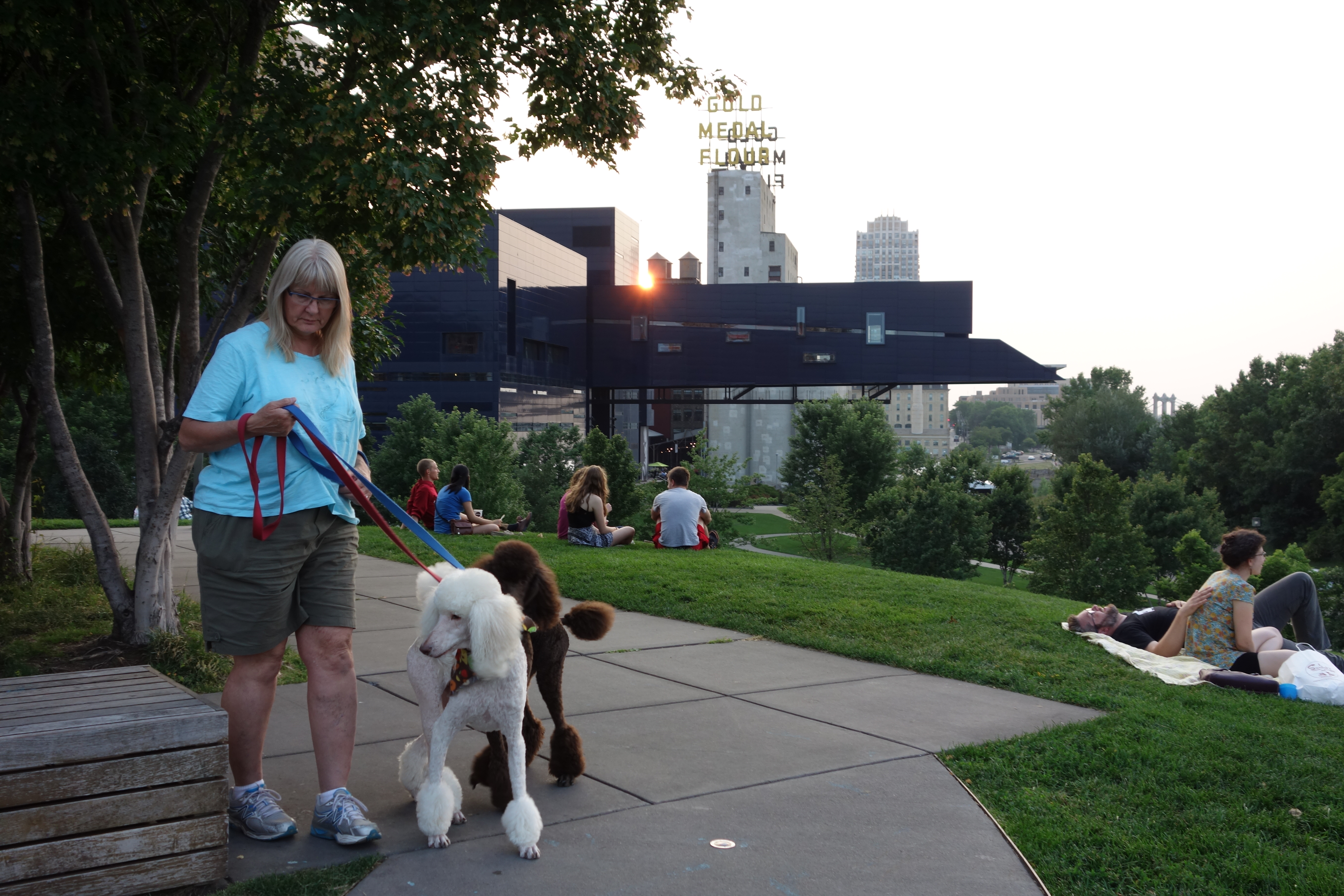
Dog lover, Minneapolis, Minnesota, 2014

Dog lover, Portland Union station, Oregon, 2014
Voting registration in the US is not straightforward. Parts of the population have no access to a picture ID and therefore have no right to vote. It is not surprising that these are the poor parts of the population. Criminals or ex-criminals have no right to vote. Consequently the participation at elections in the United States is continuously low. Even in this years election the turn-up of 67% was much lower than usually in any elections of a European state. Giving parts of the citizens the impression that their vote is not important or even excluding them can only lead to frustration.

Park Ranger, Bodie state park, California, 2010
A for me fascinating and unique US topic is the role of so-called “Gerrymandering”. The name comes from Governor Elbridge Gerry of Massachusetts, who already is 1812 redrew the borders of the congressional districts to increase the number of electors of his party. “Mandering“ comes from salamander and that refers to the weird shape some of these redrawn districts have. Some are not even a continuous area or not much wider than a highway. This practice gives the ruling party an inadequate advantage over the opposition. Nevertheless it was declared legal by the supreme court. Diamonds book shows some maps of such gerrymandered election districts.

Park ranger, Castillo de San Marcos Natinal Monument, San Agustin, Florida 2016
This year‘s elections have cost the candidates an amount of around 16 billion. The point is not that this amount is spent, but its consequences. Elected candidates get dependent on their sponsors. Fund raising becomes a task which consumes more time than actual governing. But in addition non-affluent but capable candidates are unable to run for elections. In fact, the division in rich rulers and on average poor and powerless citizens is a reflection of a society, where the three richest men (Jeff Bezos, Warren Buffett and Bill Gates) have a combined net worth equaling that of 130 million of the poorest Americans. In my view, that is not the fault of Jeff Bezos, Warren Buffett and Bill Gates. It is the fault of american politics that 130 million people are poor.

Living like the sun king: Biltmore, the estate of the Vanderbilts, Ashville, North Carolina, 2016
The question is not who wins an election but what happens afterwards. Every winner should include the loosing party and take their views into account in his policies. A politician who publicly announces to categorically refuse to compromise and to block any decision regardless of the topic is unripe to take part in politics. If he would be a manager in a company his attitude would be regarded as counterproductive and he would be immediately fired. The voters as employers of the politicians should take such an attitude into consideration.

Henry Flagler was an industrialist, the founder of Standard Oil, Miami and Palm Beach. His enormous hotel tops over San Agustin, Florida, 2016
“The United States enjoys enormous advantages. But countries can squander advantages, as has Argentina. There are warning signs that the US may be squandering their advantages today”(Jared Diamond)

The industrialization came and went, leaving behind ghosts, Butte, Montana 2014
In 1913, Argentina was the world’s 10th wealthiest state per capita. Argentina had and still has ample natural resources and a well educated population. Argentina didn’t and doesn’t have external enemies. The squandering of the wealth of the nation was entirely due to political mismanagement which eventually led that rich nation into repeated bankruptcy, hyperinflation, economic and political failure and eventually disastrous dictatorship.

Gun shops are everywhere in rural United States, even in a hotel, in case you did not sleep well, Greybull, Wyoming, 2014
link to the previous post


