Saturday, October 24, 2020

Number 41 Ethiopia 2012

"Rightfull blood"


The Mausoleum of Menelik II

When I came to Ethiopia in the beginning of 2012 the prime Minister was Meles Zenawi of the EPRDF. He had been in power since the communist tyranny under Megistu‘s Derg had been overthrown in 1991 as a consequence of failing support from the increasingly disfunct Soviet Union. His rule had become more and more dictatorial. There had been a two years war with Eritrea from 1998 to 2000 which financially exhausted both countries, and subsequent parliamentary elections in 2005 and 2010 had been acknowledged to be fraudulous by independent observers. An increasing number of opponents to the leading party disappeared. Meles died in 2012 and was replaced by his deputy Hailemariam Desalegn, who as first ethiopian ruler resigned voluntarily in 2015. By then his party was the only one in the parliament. His resignation was followed by protests, which were crushed violently. State of emergency was declared between october 2016 and August 2017. 


In the streets of old Addis Ababa


This is the contemporary background of Francesca Melandris book „sangue giusto“ (the rightful blood). An ethiopian refugee with an identity card under the name of Attilaprofeti appears at the doorstep of the teacher Ilaria Profeti in Rome and claims to be the son of an ethiopian half-brother so far unknown to her. Her father, Signor Attila Profeti, 95 years old, had been in Ethiopia as part of the Italian occupation army in world war II. Up to that moment, Ilaria and her three other brothers had no idea what her now dementing father had been doing during WW II.


Taxis and Minibusses as public transport


It is the "real blood" that is missing for those who flee seventy years later from the African states devastated by civil wars and tyranny. In Ethiopia the son of Ilaria’s brother, the immigrant, had been a teacher, but as a dissident was threatened with imprisonment and torture. After his cousin was murdered, he fled first north through the desert into the nightmare of a Libyan camp, in an overcrowded boat to Italy, where after months of waiting his fate is decided in a few minutes. His asylum application is rejected. 

From the preparations for my trip to Ethiopia I had learned a lot about the twists of ethiopean history and the colonial past but I knew little about the current political situation. My diary gives an account of my day to day impressions and during my first wanderings around the streets of Addis Ababa I note that compared to other african capitals like Bamako or Dakar the town seemed to be cleaner and less chaotic. But there were lots of, sometimes severely handicapped beggars. In front of a church I see a saw next to a human bundle on a scrap of fabric, of which one mainly saw the bare, deformed back. Women with babies sit on blankets on which passers-by have thrown coins. Several days in a row I pass a begging woman in rags with several kids sitting in the gutter. They seem to sleep there. Some beggars drag along on one leg, but there are plenty of others who do not seem to have any physical problem. I am more or less left in peace. People seem to be friendly, smile or even say hello to the faranji, the unknown foreigner. 


I had to go to the Hilton Hotel to visit the office of ethiopian airlines. The huge hotel is surrounded by a pleasant garden with swimming pool, petanque field and tennis courts. Expats and rich Africans sit at tables covered with white linen. The interior of the compound is a different world which excludes the outside. But the computer system of ethiopian airlines is down and the shops where I look for a SIM card are closed. 


When I go back into the street a little boy called Abraham starts talking to me. He tells me his story. His father is dead, his sister of 27 has a little baby, whose father died from Malaria and he has come from a village 7 km outside of Addis Ababa to earn money to support his mother, who has to pay the rent of 700 Birr, about 30 Euro. He is 9 years old and goes to school because he wants to become an engineer. Somehow he must have learned some English.


Woman reading a book in the garden of the cathedrdal


Together we walk through ethiopian history. The Beta Maryam Mausoleum holds the tomb of Menelik II, Ethiopia’s most celebrated ruler, who stopped the first attempt of italian invasion when he defeated the italian army at the battle of Adwa in 1896 and drove them back to Eritrea. In his time Addis Ababa rose from a heap of dust to the capital of the nation. The statue of the lion of Judah on its column was erected at the occasion of the coronation of Haile Selassie in 1930 and is regarded as the symbol of the ethiopian monarchy. In 1935 it was kidnapped and set up next to the Vittorio Emmanuelle monument in Rome. A young Eritrean immigrant spotted the statue and started to pray in front of it during the celebration of the Italian empire in 1938. When armed police tried to stop him he drew a sword and attacked them before he was shot. In the 1960s the monument was returned.


The lion of Judah has returned to Addis Ababa


Outside the ethnographical museum is a set of spiralling stairs, one for each year of fascist reign in Italy. There are not so many steps, but this is the time when Attilo Profeti, the shadowy main character in Francesca Melandris book, becomes involved with Ethiopia. The ethnographical museum is the former palace of Haile Selassie, Ras Tafari, which he left after a coup in 1960, when he was on a trip to Brazil. His and the empresses bedroom and bathroom are unchanged. In the paintings on the walls the bad guys are clearly distinguished by having only one eye – including the Italians. The mirror has a bullet hole from the attack in 1960. In a cupboard is a collection of official presents the Ras Tafari got from other countries. The Russian gave the model of a tank. Down the road is the Derg monument. The Derg overthrew and killed Haile Selassie in 1974 and installed a regime of terror. Under their leader, Haile Mariam Mengistu, the monument was erected to celebrate their achievements. It is still crowned with a red star and hammer and sickle. 


The stairs symbolizing the reign of fascism in Italy still survives in Ethiopia


The monument of the Derg


The monument for the victims of the Derg

The Piazza is the colonial italian town centre. A lot of the beautiful buildings are completely dilapidated. My little boy warns me about pickpockets. I spot a nice looking, almost stylish cafe. The boy wants to order a cake. The girl attending us seems to know him and pinches his cheek. She convinces him to better take a Hamburger. I also buy him the cake and a triple decker guave/avocado/orange juice. 


Piazza and Abraham in the cafe 


After we have left the cafe Abraham increases his demands for money. Next to the 700 Birr for his mother’s rent he now also needs 100 Birr for a ball for his soccer team. We pass the Ras Hotel, one of the traditional hospitable establishments in town. I give him 50 Birr, say hello and disappear through the revolving doors. He wants to follow but the porter does not let him in. I feel like a real ass hole when I see him and his disappointed face waiting outside. The coffee and mineral water I order in the cafeteria of the hotel in the midst of sedate, beer-drinking black dignitaries and bribe recipients sets me back half of the amount I have given to the kid. The telephone card I buy in the hotel shop next door costs me 40 Birr including 15 Birr credit. 


Bahre and Ethiopias first car belonging to the emperor, of course

The next day my inseparable walking companion is a 22 year old student of radiology named Bahre who is halfway his 6 years of studies. With him I end up in the holy trinity church which was built under Haile Selassie and houses his and his wife’s tombs. Their chairs also wait there for their resurrection. A guide opens a heavy but simple padlock to let us in. While the tombs are at least protected by the padlock, there are no security measures in the museum nextdoor. It is full of liturgical artefacts and the crown of Ras Tafari, mostly of pure gold or silver. 


The cathedral ....


... and the tombs with their guard


The national museum not far away relates to another chapter of history, not only ethiopian, but of humanity. In a glass box they exhibit Lucy, 3.2 million years old and reconstructed from tiny bits of fossil found in the ethiopian mud. It is unbelievable that such pieces have been recognized as being a fossil and that the few bits were sufficient to reconstruct the size and shape of the old girl. Bahre brings me to a little juice bar, where we have another fantastic drink, and introduces me to the mini bus public transport of Addis Ababa. Unfortunately it is practically impossible for a foreigner to use it without the help of a local. The destinations are posted in Amharic writing. You would have to stay here for a long time to know where to go. 


Old man in the juice bar

Upon arrival of the Italians Haile Selassie went into exile to England. But the occupation only lasted for five years. Nevertheless it came with incredible hardship for the native population. On one occasion alone, after the attempted murder of the italian vice-king Graziani in 1937, 30000 Ethiopians were killed by the occupiers. In 1941 British troops ousted the Italians.


The monument for the victims of Yekatit 12

Again it is surprising how much of such a short and violent period has survived. In 2012 the only reasonably passable road leading south through the highlands was still the one built under italian supervision in the time of occupation. Many of the presentable buildings in the provincial capitals were built in the time. Pizza, Lasagne and Spaghetti are available everywhere in Ethiopia.


Old men at the churches  


But it seems to be one characteristic of modern ethiopian history that traces of the past are not eliminated. The Derg monument still stands in the center of Addis Ababa, even though the Derg were all sentenced to death (in absence, Mengistu got exile in Zimbabwe). The remainders of ethiopian imperial history seem to be celebrated and in the national museum the portraits of Mengistu and Haile Selassie hang on the wall not far from each other.


Ras Tafari's throne


Bathroom of the Ras


Portrait of Megistu


Attilo Profeti was one of the black shirts involved in the suppression of the ethiopian population during the italian occupation. But he also had an affair with a local ethiopian woman, who got pregnant. He knew about his son but his grandchild is not welcome any more in Italy. Francesca Melandri describes how the country is interested to make money in the former colony, but not in the fate of victims and their offspring. For 10 years the author has done research, travelled to Ethiopia to find the last witnesses of the time. But this not only is a novel with an historic background, but the book also gives a relentless and satirical account of italian post-war politics, where members of populist governments and their followers in industry try to fill their pockets on the expense of the population, who voted for them, or of the former colony. Slowly Ilaria Profeti not only discovers the role of her father in the colonial history of her country, but also in the corruption and mismanagement of post-war Italy. 
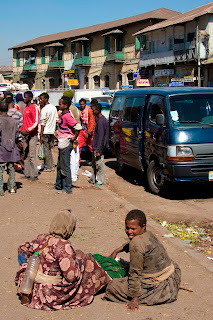
Begging women in old Addis Ababa


During my stay in Ethiopia I came back to Addis Ababa several times. Each time the diary becomes more negative. Finally I wrote: ”Why do I only now notice the ragged figures lying around the roadside? The smell of urine, exhaust fumes and dust hanging over the city? The streets full of people who don’t have anything to do for the day, and the next day, and the next week, and the next year, and their entire lives. The crowd on the sidewalks of Piazza, where suddenly a woman, a complete stranger is hugging me, probably because she wants to steal something. Suddenly all the children are pushy when they approach me with the shout "faranji - money", I roughly reject them, one of them barely escapes a slap in the face. Streets where only rusty scrap metal is sold as spare parts, loaded onto trucks by half-starved skeletons. The incompleteness of the town, where they built everywhere at the same time without finishing anything any time. The new buildings which seem to disintegrate as soon as they are finished. The few river beds where dusty vegetation is surrounded by a sluggishly flowing, stinking cloak full of rubbish.” 


Beggar in the street

Probably the drought in the two years before 2012 drove many from the countryside into the city. That and the subsequent political turmoil drove people into emigration like the boy suddenly turning up at Ilaria Profeti’s front door. It could have been the little boy who guided me around Addis Abeba. 


The donkey is still needed in Addis Ababa


But there are also positive aspects. The Chinese have made big investments, built a new railroad and have replaced the old italian built mountain road by a highway. And Bahre is well, got a job and just got married to a beautiful woman….
"In post-war Italy, the ex-colonialists were even more invisible than the ex-fascists" (Francesca Melandri"


Sunday, October 18, 2020

Number 40 Germany 1991

The first or the last winter in freedom


In 1989 i lived in the house of a friend in United States. When I came home the evening of November 9th the friend sat in his living room staring at the television dumbfounded. We could not believe what we saw. After living in the US for a while both of us had lost track of what was going on at home. We had noticed that there were demonstrations in East Germany, that people who wanted to leave were crowded in the embassy in Prague and others had taken the route via Hungary, which had finally torn down the border fences. But that people were able to ignore the border and stand on the wall in Berlin without brutal consequences, that the border fortifications were even treated with pickaxes and hammers was beyond our imagination. We first thought we were looking at a new fantasy product made in Hollywood. But only two days later the first supermarkets in LA sold bags containing little chips of concrete covered with paint of the dismantled Berlin wall. 


Boats on the snowy beach of Rügen

The demolition of the wall was neither the beginning nor the end of the reunification process. The Brandenburg gate in Berlin was officially opened only by December 22th, 1989. On August 23rd, 1990 the Volkskammer of the GDR signed a resolution declaring the accession of the east German Democratic Republic to the Federal Republic of Germany. The application of the Federal Republic's Basic Law to the territory of East Germany was effective only by October 3rd, 1990. East Germany added five additional states to the Federal Republic of Germany, Sachsen, Thüringen, Sachsen-Anhalt, Brandenburg and Mecklenburg-Vorpommern, which held their first elections on October 14th, 1990. 


The frozen beach

Meanwhile I had moved back to Germany and was living in Munich. Visiting the GDR before reunification had been rather difficult for a west german without relatives in East Germany or other connections. I had been there a couple of times. It had been brief peeks into a different world. Now I myself and many of my friends were eager to go there and have a look before business, commercialism, and the victorious western way of life had changed everything. Probably the same motivation which still continues to drive me out to other faraway countries. 


Ice in the little port of Lauterbach 

I had bought a big Opel Rekord stationwagon which had got the nick-name of “the tank” by some of my friends and “the bluesmobil” by others. In the middle of a snow-storm in the beginning of 1991 we decided to drive it up to the island of Rügen at the coast of the Baltic sea, about the most remote place you could go to at the time in the middle of winter in Germany. In California a little tour of 900 km would have been a relaxed weekend trip. In winter Germany it was an adventure. 


The bluesmobil on the snowy alley roads of the island 

A big part of the motorways in East Germany still had the original concrete plated surface from before WWII. The regular tock tock – tock tock sound accompanied you along the way. At least these motorways usually were free of potholes. Some secondary roads had them in the size of a wheel. And since the fall of the wall the Vopo’s had disappeared. “Volkspolizei”, the people’s police, which were hiding somewhere and trying to fine you or even search, arrest or expel you for any random reason in the time before. 


In the main street of Binz


The motorway ended at the seaport of Rostock, in GDR times their biggest port. From there a secondary road led via Stralsund and a lifting bridge to the island. Since reunification the organization responsible for the road maintenance had received some snow removal equipment, so the main roads were more or less free of ice and snow. That changed on the island. The recently formed districts had little money and the towns even less. The roads were covered in ice and snow. The rear wheel driven bluesmobil had to be handled with utmost care because the light-weight back of the car tended to slide sideways. Fortunately there are few hills in this part of the world, but on some it helped to put my friend into the big loading area of the car to give it some more traction. Downhill the backwheels seemed to like to pass the frontwheels. 


One of the Trabis

Eventually we arrived in the little and almost deserted seaside resort of Binz. That was the time when many people tried to make some extra money by renting out a spare room in their apartment. We rented the bedroom of somebody, while the owner slept on the sofa in the living room. A rich breakfast was included in the very reasonable price. 


Two of the old villas 


The place where we stayed 

Binz used to be a fashionable resort before WWII. There were plenty of art nouveau villa’s with the typical wooden verandas and balconies. In the times of communism tourism was not the first priority. Many of these big places were converted into little apartments by crude subdivisions where whole families lived year-round. The place where we stayed was one of those. 


Restaurants were also rather scarce in the GDR. The service usually was downright rude if they were graceful enough to give you a table in an otherwise empty restaurant while outside a long queue was waiting. Now, in snowy Binz, everything was closed except of the restaurant in the Kurhaus, an old and enormous palace of recreation right on the icy beach. There was also a bar, the only place to have a drink at night. Everything was covered in red velvet. Nobody was performing on the stage. We were basically the only guests. The beer in East Germany was always good and very cheap. You could dream away and imagine the times when this was a place only allowed for high functionaries or foreign guest, where Russian generals had the girls dance on the tables. 


The Kurhaus, seat of the restaurant and nightclub 

The island has a coastline of 600 km. The spray of the waves on the sandy beaches had been frozen to plates of ice. Behind the beaches were campgrounds covered in snow and ice. These were the places where the communist comrades fancied to spend their summer vacation. The most famous part of the coast are the chalk cliffs of Jasmund. The romantic painter Caspar David Friedrich spent a lot of time on Rügen to paint the shiny white cliffs. In this winter they disappeared in the whiteness of ice and snow. 


The beach promenade of beach and the chalk cliffs in the background


View from the top of the cliffs of Jasmund 


The best way to warm up after a walk in the biting cold was to take the train. All the station buildings were open and well heated. The island used to have an extensive network of narrow gauge railways and one line was still operating. The steam engines converted the bleak interior of the ancient wagons into a tropical sauna. There were many trains and very few passengers. 


Vehicles in the streets of Binz


The old Opel was by far the biggest car around. Most of the few cars on the island were still the famous Trabi, the east German car with two stroke engine, plastic body, a loud rattling sound and blueish smoke from the exhaust pipe. In the times of the GDR they were highly esteemed and people had to wait as long as 15 years after their ordered car was eventually delivered. After reunification they quickly disappeared. 


One of the campgrounds on the beach


Each day I was afraid the bluesmobil would not start any more after the cold night. But it did. And we eventually made it back to Munich, but only just, because the car behaved more and more strange and back home it turned out that the camshaft had a problem. 


Old reed covered village houses on Rügen 


I have been back to Rügen several times in the nineties and each time there was some more development. But fortunately, only few weeks before reunification and their own abolition, the East German government made one last, and maybe the only ever far-sighted decision: they converted about 10% of their area into national parks. This and the lesson planners had learned from the development and destruction of many seaside resorts between Scheveningen and Benidorm resulted in a mainly sustainable development of the east german coast which took in account the historic building infrastructure and the countryside. The old villas were renovated and new buildings had to be built in the style of what was already there. The outside of the Kurhaus in Binz looks basically the same as in 1990. The stations along the narrow gauge railway line were renovated and they are still in use. The line was even extended by a short branch and is still operated with the same old steam engines. Availability of restaurants, their quality and service has greatly improved. It is still a fantastic place to go to. But it is not empty any more.


The narrow gauge train in the terminal of Göhren


The historic station of Binz


Inside one of the narrow gauge wagons


The winter 1990/1991 was not the last which was really cold. There was another one in 2010/2011. Around New Year I spent a week at the german North Sea coast. The waddenzee was frozen. This week produced some spectacular photos for another story.